

Wouldn't it be great if learning history could feel as exciting as a treasure hunt, where kids don’t just read about ancient civilizations—they actually step into them. Picture them walking through the streets of Rome, building the Great Wall of China, or trading goods in a bustling medieval market. Here’s the secret: when learning history with Minecraft, it turns the past into a vivid, interactive experience that your kids won’t just learn from—they’ll remember it for years.
Think back to when you first discovered your love for history—maybe it was through a captivating book, an engaging documentary, or an unforgettable field trip. Now, you have the chance to give your students that same sense of discovery, but in a way that lets them become part of the story. With Minecraft, they can explore historical settings, recreate pivotal events, and even collaborate to solve the challenges of the past. It’s like handing them a time machine and a blank canvas, where each lesson becomes an adventure through time, sparking curiosity and making history come alive in a way traditional methods just can’t match.
Minecraft brings history to life for students. This block-building game is a powerful tool for teaching history. It makes abstract historical concepts tangible and exciting. Students can explore ancient worlds and recreate historical events. Minecraft Education Edition turns classrooms into virtual worlds. This hands-on approach sparks curiosity and encourages active learning. A New Zealand class used Minecraft to recreate the Battle of Gate Pa. Students became builders, landscapers, and warriors in this immersive experience. They understood the event better than textbooks could teach. This method brings the past to life.
Minecraft has grown from a simple game to an educational tool. It's now the best-selling video game ever, and learning history with Minecraft is making history fun again.
Minecraft Education Edition has transformed classrooms by turning them into virtual worlds, allowing students to actively engage in learning historical concepts. Through this immersive experience, students can recreate historical events and explore ancient civilizations, promoting active learning and sparking curiosity. By becoming builders, landscapers, and warriors in the game, students gain a deeper understanding of historical events, surpassing what traditional textbooks can offer. Minecraft's educational power lies in its ability to make history tangible and exciting, making it the bestselling video game ever for educational purposes.
Minecraft was created by Mojang in 2009 and bought by Microsoft. It's now a great platform for learning through games.
Its open world helps kids be creative and solve problems. This makes it perfect for teaching in fun ways.

Minecraft Education Edition came out in 2016. It has cool features like Code Builder and Chemistry Lab.
The platform offers lesson plans in many subjects. It even has lessons about World War I and Ancient Egypt!
Minecraft can create amazing virtual worlds for learning. Students can explore old places and work on projects together.
At Harvard Westlake School, Latin students built Roman buildings in Minecraft. This made ancient architecture come alive for them.
Minecraft turns learning into an exciting adventure. Teachers love using it to make their classes more fun.
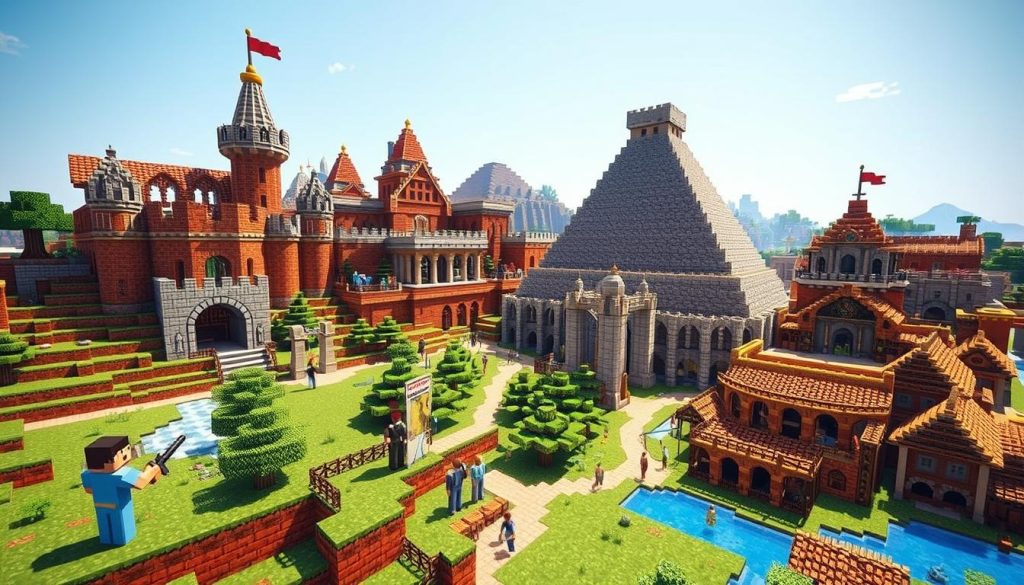
Minecraft is changing how we teach and learn history. It's a powerful tool for creating engaging, interactive history lessons.
Students are bringing the past to life through exciting historical recreations. These projects spark creativity and critical thinking in young learners.
Fifth-graders recreated ancient Olisipo, the Roman-era Lisbon, in Minecraft: Education Edition. They learned about Roman architecture and urban planning while building the city.
The World War I Lesson Pack for Minecraft: Education Edition is another great example. It covers five key aspects of the conflict in detail.
These lessons mix in-game activities with research, writing, and discussions. High school students gain a deeper understanding of World War I's complexities.
"Using Minecraft in history education has shown a positive impact on student creativity, critical thinking, and autonomous learning."
Minecraft lets students step into historical settings and assume new identities. They gain firsthand experience of geographical and historical contexts.
This hands-on approach boosts engagement and improves knowledge retention. Students enjoy learning history like never before.
Minecraft changes how students learn together. It's fun and teaches real-world skills at the same time.
Minecraft creates a space where all students can excel. Kids from different backgrounds work together on cool projects.
Almost every 10-year-old in America knows Minecraft. This means no one feels left out.
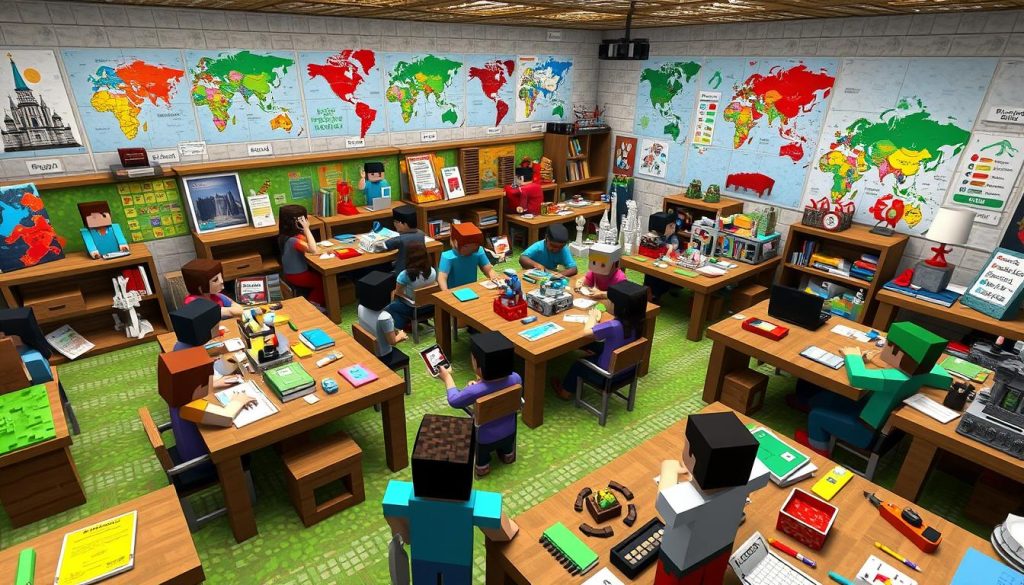
Minecraft teaches more than just building blocks. Students learn planning, problem-solving, and team management.
The game's chat features help improve communication skills. These are all important for future jobs.
A project called "My Country, Your Country" showed Minecraft's power. Students worked together to recreate Portugal in the game.
They learned about geography, history, and complex math. The project covered topics like volume and perimeter.
The results were amazing. Students were more engaged and did better on tests.
Minecraft proves to be more than just a game. It's a tool for learning real-world skills.
Minecraft sparks creative learning in history classes. Students dive into virtual worlds, tackling historical challenges with fresh eyes.
They're developing problem-solving skills that stick. Kids aren't just memorizing facts anymore.
93% of teachers saw better critical thinking with Minecraft Education Edition. This game is a powerful tool for historical thinking.
Kids recreate ancient cities and solve resource shortages. They experience past events in new ways.
Students rebuilt the Roman Colosseum in one exciting project. They researched architecture and debated design choices.
This hands-on approach boosted their understanding and engagement. Working together, they brought history to life.
"Minecraft helped my students think outside the box about historical problems. They're more curious and creative now," shared a history teacher I interviewed.
The game's open-ended nature encourages kids to experiment. They try different solutions to historical problems.
Students might test farming methods in a medieval village sim. Or they could try defense strategies in a castle build.
Minecraft blends history, technology, and imagination. It's changing how we teach about the past.
The game turns passive learners into active problem-solvers. Students are ready to tackle both historical and modern-day challenges.
Minecraft changes how students learn about history. It makes historical ideas real and easy to understand.
Students get more curious and interested in the past. I've seen how it brings history to life better than books.
Minecraft lets students build historical sites block by block. They can make the Roman Colosseum or walk through a virtual Globe Theatre.
This hands-on method helps students grasp and remember important historical ideas. It turns abstract concepts into concrete experiences.
With Minecraft, students don't just read about history. They live it through active learning experiences.
They can give speeches as Abraham Lincoln. Or they can walk the streets of ancient Florence.
Minecraft's open world lets students explore and discover freely. They can make timelines, virtual tours, or historical debates.
This freedom makes students curious. It turns history into an exciting adventure they want to learn about.
"Minecraft has revolutionized how we teach history. It's not just about dates and facts anymore. It's about experiencing the past and making it relevant to today's students."
Teachers can use Minecraft to make history lessons more fun. Students can interact with the past in new ways.
This method helps students think critically about complex historical stories. It also improves their problem-solving skills.
Minecraft turns history lessons into exciting adventures. Students team up to rebuild the past in this interactive game.
My recent workshop focused on recreating World War II events. We explored the incarceration of Japanese Americans through virtual building.
Historical reconstruction in Minecraft is both fun and educational. Students build ancient cities and battlefields, learning as they go.
This hands-on approach makes history easy to remember. It brings the past to life in a new way.
"Minecraft turns students into time travelers, architects, and historians all at once!"
Teamwork is key in these projects. Students work together to solve problems and divide tasks.
This teaches real-world skills they'll use later. Even reluctant learners get excited about history through Minecraft.
Minecraft creates a unique way to learn about history. It builds understanding, empathy, and critical thinking skills.
These skills will help students long after the game ends. Minecraft makes history come alive in amazing ways.
Minecraft transforms history lessons in amazing ways. It offers over 600 standards-aligned lessons for curriculum integration.
This game brings history to life in classrooms. Let's explore how we can use it effectively.
Planning lessons with Minecraft is fun and engaging. I choose a historical event or period to focus on.
Students can recreate key moments or build historical structures. They might construct the Great Wall of China.
Minecraft Education Edition meets educational standards well. It covers history and digital skills in various subjects.
My lessons meet learning goals while keeping students interested. This works great in schools across the U.S.
Assessing Minecraft learning needs creative methods. I use quizzes and project-based evaluations.
Students can submit screenshots or present their historical builds. This shows their understanding and creativity.
"Minecraft has revolutionized how we teach history. It's not just a game; it's a powerful educational tool that brings the past to life."
Minecraft makes history come alive for students. It's an exciting tool in educational technology.
This approach creates immersive experiences beyond just teaching facts. It's shaping our classrooms in new ways.
Minecraft has changed how we teach history. Its impact goes beyond just being a fun game.
With 125 million monthly players, Minecraft is a great tool for teaching history. Many people see its value in classrooms.
Minecraft Education Edition is used in over 6,500 schools worldwide. It helps students learn history in new ways.
Here's why Minecraft is so effective for teaching history:
Minecraft's YouTube community helps people learn about history. Students can explore history outside of school in fun ways.
Minecraft has become an educational tool used to teach critical content in various disciplines, including history.
Most students think games make classes more fun. Minecraft is changing how we teach history in the digital age.
Minecraft has transformed history education. It has engaged over 100 million users worldwide. This game is now used by 35 million teachers and students.
Students spend over 1 billion hours in Minecraft. They have created more than 130 million worlds. In Ms. Wenzel's class, students use Minecraft to present historical claims.
The future of history teaching looks bright with Minecraft. We can expect more exciting ways to learn about the past. Ireland's €210 million grant will help grow Minecraft's role in education.
Minecraft Education Edition is a special version of the popular game Minecraft. It helps students learn in fun and exciting ways.
Minecraft lets students build and explore historical places and events. This hands-on approach makes history more real and interesting for them.
Minecraft helps students learn in ways that connect to real life. It improves math skills and teamwork, as shown in studies.
In Minecraft, students can change their world to solve problems. This helps them think creatively about historical challenges.
Minecraft brings history to life through virtual worlds. Students can explore and learn on their own, making history more fun.
Students can work together in Minecraft to rebuild historical places. This teamwork helps them learn more about history and each other.
Teachers can use Minecraft lessons that fit their history classes. They can change these lessons to meet their students' needs.
Minecraft has a big impact on how people learn history. Its YouTube community helps people share knowledge and learn together.
It's crucial to introduce children to the incredible women who have shaped our world. Their stories are not only inspiring but also serve as powerful lessons in perseverance, courage, and innovation. Learning about these women helps kids, especially young girls, see the limitless possibilities for their futures.
When children learn about influential women, they gain a broader understanding of history and the diverse contributions that have shaped our society. This knowledge fosters a sense of respect and admiration for the achievements of women across various fields.
Most importantly, these stories can inspire young girls to dream big and pursue their goals with determination. By seeing the obstacles these women overcame, children learn that they too can achieve great things, regardless of the challenges they may face.
Besides that, learning about women in history promotes gender equality. It helps dismantle stereotypes and biases, encouraging kids to appreciate the talents and abilities of everyone, regardless of gender.
Let's dive into the stories of some trailblazing women who have left an indelible mark on history. These women come from various backgrounds and fields, but they all share a common trait: an unwavering commitment to their passions and a desire to make a difference.
Marie Curie was a groundbreaking scientist known for her research on radioactivity. She was the first woman to win a Nobel Prize and remains the only person to have won Nobel Prizes in two different scientific fields—Physics and Chemistry.
Curie's discoveries have had a lasting impact on science and medicine. Her work with radium and polonium paved the way for advancements in cancer treatment and nuclear energy.
Teaching kids about Marie Curie can spark an interest in science and show them the importance of perseverance in the face of adversity. Despite facing significant obstacles as a woman in a male-dominated field, Curie's passion for science never wavered.
Amelia Earhart was a pioneering aviator who became the first woman to fly solo across the Atlantic Ocean. Her fearless spirit and determination made her a symbol of women's empowerment and adventure.
Earhart's achievements in aviation broke barriers and opened doors for future generations of female pilots. Her story teaches kids about the importance of setting ambitious goals and pursuing them with courage.
Besides her flying feats, Earhart was also an advocate for women's rights and encouraged women to pursue careers in aviation and other fields traditionally dominated by men.
"You must never be fearful about what you are doing when it is right." - Rosa Parks
Rosa Parks is best known for her pivotal role in the Montgomery Bus Boycott. By refusing to give up her seat to a white passenger, Parks ignited a movement that led to significant advancements in the fight for civil rights.
Parks' story is a powerful example of how one person's actions can spark change. Teaching kids about her bravery and determination helps them understand the importance of standing up for what is right, even in the face of adversity.
Malala Yousafzai is a Pakistani activist for girls' education and the youngest-ever Nobel Prize laureate. Despite facing life-threatening challenges, she has continued to advocate for the right of all children, especially girls, to receive an education.
Malala's story is one of resilience and unwavering commitment to her cause. By sharing her journey with kids, we can inspire them to value education and understand the power of their voices in creating change.
Through her activism, Malala has shown that age is not a barrier to making a significant impact. Her message resonates with young people worldwide, encouraging them to stand up for their rights and the rights of others.
Books are a fantastic way to introduce kids to the stories of influential women. They provide a detailed and engaging narrative that can captivate young minds and inspire them to dream big. Here are some excellent book recommendations:
Reading these books can help kids understand the impact of these women and inspire them to pursue their own dreams with determination and courage.
Engaging kids in discussions about the contributions of women throughout history is essential. It helps them process what they've learned and apply it to their own lives. Here are some ways to facilitate these discussions: Famous Women in History
It's important to highlight the obstacles that these women faced and overcame. Discussing these challenges can help kids appreciate the resilience and determination required to achieve great things.
For example, Marie Curie faced significant gender bias in the scientific community, yet she persevered and made groundbreaking discoveries. Similarly, Rosa Parks faced racial discrimination but stood her ground, igniting a movement for civil rights.
Help kids draw connections between the achievements of women in history and the opportunities available to them today. Discuss how the efforts of women like Malala Yousafzai have paved the way for greater access to education for girls worldwide.
Encourage kids to think about how they can contribute to making the world a better place. Ask them questions like, "What can you do to stand up for what you believe in?" or "How can you make a difference in your community?" For inspiration, consider learning about famous women in history who have made significant contributions.
While it's important to learn about historical figures, it's equally crucial to introduce kids to modern role models. These contemporary women can show kids that they, too, can achieve great things in today's world.
Highlighting women who are making strides in STEM fields can inspire kids to pursue careers in science, technology, engineering, and mathematics. Some notable STEM innovators include:
Political leaders and activists play a vital role in shaping society and advocating for change. Introducing kids to these figures can inspire them to get involved in their communities and stand up for their beliefs.
"Every great dream begins with a dreamer. Always remember, you have within you the strength, the patience, and the passion to reach for the stars to change the world." - Harriet Tubman
Some influential political leaders and activists include:
Athletes and artists also serve as powerful role models for kids. Their dedication to their craft and their ability to overcome obstacles can inspire kids to pursue their passions, whether in sports, music, art, or other creative fields.
Some inspiring athletes and artists include:
Women's History Month is a fantastic opportunity to celebrate the achievements of women and inspire kids to learn more about their contributions. Here are some practical ways to celebrate:
"The more you celebrate your life, the more there is in life to celebrate." - Oprah Winfrey
Creating Women's History Badges is a fun and educational activity that allows kids to learn about influential women and showcase their creativity. Here's how you can do it:
This activity not only educates kids about women's history but also allows them to practice their research and presentation skills.
Creating Women’s History Badges is a fun and educational activity that allows kids to learn about influential women and showcase their creativity. Here's how you can do it:
This activity not only educates kids about women's history but also allows them to practice their research and presentation skills.
Setting up a classroom or home museum is an interactive way to celebrate Women’s History Month. It provides a hands-on learning experience that can deepen kids' understanding and appreciation of women's contributions. Here’s how to set it up:
This project encourages kids to dive deeper into their research and allows them to share their knowledge with others in a creative and engaging way. For more inspiration, check out famous women in history.
As we celebrate and learn about the achievements of women in history, it's natural to have questions. Here are some frequently asked questions and their answers to help guide your learning journey.
By celebrating Women’s History Month, we ensure that the stories of influential women are passed down to future generations, fostering a more inclusive and equitable society.
There are many resources available to help you learn more about women in history. Here are some suggestions:
These resources can provide a wealth of information and help you explore the lives and achievements of women throughout history.
Teaching kids about women in history can be both fun and educational. Here are some easy ways to incorporate these lessons into your teaching:
These methods can make learning about women in history engaging and memorable for kids.
While many kids are familiar with figures like Marie Curie and Rosa Parks, there are countless lesser-known women who have made significant contributions to history. Here are a few examples:
Learning about these women can broaden kids' understanding of history and inspire them with diverse examples of courage and innovation.
Celebrating women’s achievements has a profound impact on both girls and boys. Here’s how:
By highlighting the stories of influential women, we inspire the next generation to strive for greatness and work together to create a better future.
Learning world history for kids is like embarking on a grand adventure. It's not just about memorizing dates and names; it's about uncovering thrilling tales of bravery, innovation, and discovery. When kids dive into history, they encounter epic stories that are more exciting than any movie or video game.
Understanding world history helps kids appreciate the diversity and complexity of human cultures. It gives them a sense of where we come from and how past events have shaped our present. Most importantly, history teaches valuable lessons that can inspire kids to make a positive impact on the future.
Ancient civilizations are like the foundation stones of human history. They laid the groundwork for modern society with their incredible achievements in architecture, governance, and culture. Exploring these ancient worlds can be both fun and educational for kids.
Explorers are the real-life adventurers who dared to venture into the unknown. Their journeys opened up new lands and brought different cultures into contact with each other. Learning about these explorers can ignite a sense of curiosity and wonder in kids.
Battles have often been turning points in history. They can be dramatic and intense, with heroes and heroines emerging from the chaos. Understanding these battles helps kids grasp the complexities of conflict and the importance of strategy and leadership. For more insights, visit History for Kids.
Innovation has always driven human progress. From the invention of the wheel to the landing on the moon, groundbreaking discoveries have transformed the way we live. Learning about these inventions can inspire kids to think creatively and pursue their own ideas.
Throughout history, certain individuals have stood out for their extraordinary contributions. Whether they were leaders, artists, scientists, or activists, these influential figures have left a lasting impact on the world. Studying their lives can provide kids with role models and inspiration.
Ancient Egypt is one of the most fascinating civilizations in history. Known for its majestic pyramids and powerful pharaohs, Egypt was a land of innovation and mystery. The pyramids, built as tombs for the pharaohs, are among the most iconic structures in the world.
Besides that, the ancient Egyptians made significant advances in medicine, mathematics, and engineering. Their hieroglyphic writing system was one of the earliest forms of written communication. Exploring the world of ancient Egypt can spark a child's imagination and curiosity.
Ancient Greece is often called the cradle of Western civilization. It was a place where democracy was born, and where great philosophers like Socrates, Plato, and Aristotle pondered the mysteries of life. Greek mythology, with its gods and heroes, is full of captivating stories that have been told for centuries.
The Greeks also excelled in the arts and sciences. They made groundbreaking contributions to architecture, drama, and astronomy. Learning about ancient Greece can help kids understand the roots of modern Western culture and the importance of critical thinking.
Ancient Rome was a powerful empire that dominated much of Europe, North Africa, and the Middle East. The Romans were master builders, known for their impressive aqueducts, roads, and buildings. The Colosseum, where gladiators once fought, is a testament to their engineering prowess.
Roman law and governance laid the foundation for many modern legal systems. The Latin language, spoken by the Romans, influenced many languages spoken today. By studying ancient Rome, kids can learn about the rise and fall of empires and the lasting impact of Roman innovations.
Christopher Columbus is one of the most famous explorers in history. In 1492, he set sail from Spain with the goal of finding a new route to Asia. Instead, he stumbled upon the Americas, opening up a whole new world for European exploration and colonization.
Columbus's voyages were filled with challenges and discoveries. He made four trips to the New World, each time bringing back valuable information about the lands he encountered. Learning about Columbus's adventures can teach kids about the Age of Exploration and the impact of European colonization on indigenous peoples.
Marco Polo was a Venetian merchant and explorer who traveled extensively through Asia in the 13th century. His journey took him along the Silk Road, reaching as far as China, where he served at the court of Kublai Khan. Marco Polo's detailed accounts of his travels introduced Europeans to the wonders of the East, including its culture, technology, and wealth.
His book, "The Travels of Marco Polo," became a bestseller and inspired many other explorers, including Christopher Columbus. Marco Polo's adventures teach kids about the importance of curiosity, perseverance, and the exchange of ideas between different cultures.
Throughout history, certain battles have stood out for their significance and impact. These battles often marked turning points in history, shaping the future of nations and civilizations. Understanding these legendary battles can provide kids with insights into strategy, leadership, and the consequences of conflict.
The Battle of Thermopylae is one of the most famous battles in ancient history. In 480 BC, a small Greek force led by King Leonidas of Sparta held off a much larger Persian army at a narrow pass called Thermopylae. Despite being vastly outnumbered, the Spartans' bravery and tactical skill became legendary.
The story of the 300 Spartans has been immortalized in literature and film. It teaches kids about courage, sacrifice, and the importance of standing up for one's beliefs, even in the face of overwhelming odds.
The Battle of Hastings took place in 1066 and was a pivotal moment in English history. William the Conqueror, the Duke of Normandy, defeated King Harold II of England, leading to the Norman conquest of England. This battle changed the course of English history, introducing Norman culture, language, and governance.
Learning about the Battle of Hastings helps kids understand the impact of conquest and cultural integration. It also highlights the significance of leadership and strategy in determining the outcome of historical events.
The American Revolution was a monumental conflict that led to the birth of the United States. From 1775 to 1783, American colonists fought against British rule to gain their independence. Key battles such as the Battle of Bunker Hill, the Siege of Yorktown, and the Battle of Saratoga were crucial in securing victory for the American forces.
The American Revolution teaches kids about the values of freedom, democracy, and the power of collective action. It also underscores the importance of resilience and determination in achieving one's goals.
Inventions and discoveries have played a crucial role in shaping human history. These breakthroughs have revolutionized the way we live, work, and communicate. Understanding these innovations can inspire kids to think creatively and pursue their own ideas.
The invention of the printing press by Johannes Gutenberg in the 15th century was a game-changer for the dissemination of information. Before the printing press, books were copied by hand, making them rare and expensive. The printing press allowed for the mass production of books, making knowledge more accessible to people.
This invention played a significant role in the spread of ideas during the Renaissance and the Reformation. It also paved the way for the scientific revolution and the Enlightenment. Learning about the printing press helps kids appreciate the importance of communication and the power of the written word.
"The printing press is the greatest invention of the past thousand years. It changed the course of human history." – Steven Pinker
Electricity is one of the most important discoveries in human history. Pioneers like Benjamin Franklin, Thomas Edison, and Nikola Tesla made significant contributions to our understanding and use of electricity. From the invention of the light bulb to the development of electrical grids, electricity has transformed every aspect of our lives.
Understanding the history of electricity can inspire kids to explore the world of science and technology. It also highlights the importance of innovation and the impact of scientific discoveries on society.
Space exploration represents the pinnacle of human curiosity and ambition. The Apollo 11 mission in 1969, which landed the first humans on the moon, was a monumental achievement. Astronauts Neil Armstrong and Buzz Aldrin became the first people to walk on the lunar surface, while Michael Collins orbited the moon in the command module.
The famous words, "That's one small step for man, one giant leap for mankind," spoken by Armstrong, captured the significance of this achievement. Learning about space exploration can inspire kids to dream big and pursue careers in science, technology, engineering, and mathematics (STEM).
Throughout history, certain individuals have made extraordinary contributions that have shaped the world we live in today. Studying these influential figures can provide kids with role models and inspire them to make a positive impact on the world.
Alexander the Great was one of history's most successful military leaders. Born in 356 BC, he became king of Macedonia at the age of 20 and embarked on a campaign of conquest that created one of the largest empires in history. His empire stretched from Greece to Egypt and into India.
Alexander's leadership and strategic brilliance made him a legendary figure. His achievements teach kids about the importance of vision, ambition, and the ability to inspire others. Despite his early death at the age of 32, Alexander's legacy continues to influence the world.
Leonardo da Vinci's life and work inspire kids to explore multiple interests and pursue knowledge with passion and creativity. His legacy as the quintessential Renaissance man demonstrates the value of a well-rounded education.
Mahatma Gandhi was a leader of the Indian independence movement against British rule. Born in 1869, Gandhi advocated for nonviolent resistance and civil disobedience as means to achieve political and social change. His philosophy of "Satyagraha" emphasized truth and nonviolence.
Gandhi's leadership and dedication to peaceful protest inspired movements for civil rights and freedom across the world. His legacy teaches kids about the power of compassion, resilience, and the importance of standing up for justice.
"Tell me and I forget, teach me and I may remember, involve me and I learn." – Benjamin Franklin
Interactive activities and resources can make learning history fun and engaging for kids. By involving them in hands-on activities, we can help them better understand and retain historical knowledge.
Here are some interactive resources for exploring world history:
By incorporating these resources into their learning, kids can develop a deeper understanding of history and its relevance to the present and future.
Marco Polo's adventures teach kids about the importance of curiosity, perseverance, and the exchange of ideas between different cultures.
Throughout history, certain battles have stood out for their significance and impact. These battles often marked turning points in history, shaping the future of nations and civilizations. Understanding these legendary battles can provide kids with insights into strategy, leadership, and the consequences of conflict.
The Battle of Thermopylae is one of the most famous battles in ancient history. In 480 BC, a small Greek force led by King Leonidas of Sparta held off a much larger Persian army at a narrow pass called Thermopylae. Despite being vastly outnumbered, the Spartans' bravery and tactical skill became legendary.
The story of the 300 Spartans has been immortalized in literature and film. It teaches kids about courage, sacrifice, and the importance of standing up for one's beliefs, even in the face of overwhelming odds.
The Battle of Hastings took place in 1066 and was a pivotal moment in English history. William the Conqueror, the Duke of Normandy, defeated King Harold II of England, leading to the Norman conquest of England. This battle changed the course of English history, introducing Norman culture, language, and governance.
Learning about the Battle of Hastings helps kids understand the impact of conquest and cultural integration. It also highlights the significance of leadership and strategy in determining the outcome of historical events.
The American Revolution was a monumental conflict that led to the birth of the United States. From 1775 to 1783, American colonists fought against British rule to gain their independence. Key battles such as the Battle of Bunker Hill, the Siege of Yorktown, and the Battle of Saratoga were crucial in securing victory for the American forces.
The American Revolution teaches kids about the values of freedom, democracy, and the power of collective action. It also underscores the importance of resilience and determination in achieving one's goals.
Inventions and discoveries have played a crucial role in shaping human history. These breakthroughs have revolutionized the way we live, work, and communicate. Understanding these innovations can inspire kids to think creatively and pursue their own ideas.
The invention of the printing press by Johannes Gutenberg in the 15th century was a game-changer for the dissemination of information. Before the printing press, books were copied by hand, making them rare and expensive. The printing press allowed for the mass production of books, making knowledge more accessible to people.
This invention played a significant role in the spread of ideas during the Renaissance and the Reformation. It also paved the way for the scientific revolution and the Enlightenment. Learning about the printing press helps kids appreciate the importance of communication and the power of the written word.
"The printing press is the greatest invention of the past thousand years. It changed the course of human history." – Steven Pinker
Electricity is one of the most important discoveries in human history. Pioneers like Benjamin Franklin, Thomas Edison, and Nikola Tesla made significant contributions to our understanding and use of electricity. From the invention of the light bulb to the development of electrical grids, electricity has transformed every aspect of our lives.
Understanding the history of electricity can inspire kids to explore the world of science and technology. It also highlights the importance of innovation and the impact of scientific discoveries on society.
Space exploration represents the pinnacle of human curiosity and ambition. The Apollo 11 mission in 1969, which landed the first humans on the moon, was a monumental achievement. Astronauts Neil Armstrong and Buzz Aldrin became the first people to walk on the lunar surface, while Michael Collins orbited the moon in the command module.
The famous words, "That's one small step for man, one giant leap for mankind," spoken by Armstrong, captured the significance of this achievement. Learning about space exploration can inspire kids to dream big and pursue careers in science, technology, engineering, and mathematics (STEM).
Throughout history, certain individuals have made extraordinary contributions that have shaped the world we live in today. Studying these influential figures can provide kids with role models and inspire them to make a positive impact on the world.
Alexander the Great was one of history's most successful military leaders. Born in 356 BC, he became king of Macedonia at the age of 20 and embarked on a campaign of conquest that created one of the largest empires in history. His empire stretched from Greece to Egypt and into India.
Alexander's leadership and strategic brilliance made him a legendary figure. His achievements teach kids about the importance of vision, ambition, and the ability to inspire others. Despite his early death at the age of 32, Alexander's legacy continues to influence the world.
Leonardo da Vinci's life and work inspire kids to explore multiple interests and pursue knowledge with passion and creativity. His legacy as the quintessential Renaissance man demonstrates the value of a well-rounded education.
Mahatma Gandhi was a leader of the Indian independence movement against British rule. Born in 1869, Gandhi advocated for nonviolent resistance and civil disobedience as means to achieve political and social change. His philosophy of "Satyagraha" emphasized truth and nonviolence.
Gandhi's leadership and dedication to peaceful protest inspired movements for civil rights and freedom across the world. His legacy teaches kids about the power of compassion, resilience, and the importance of standing up for justice.
"Tell me and I forget, teach me and I may remember, involve me and I learn." – Benjamin Franklin
Interactive activities and resources can make learning history fun and engaging for kids. By involving them in hands-on activities, we can help them better understand and retain historical knowledge.
Timelines and maps are excellent tools for visualizing historical events and geographical changes over time. Creating a timeline of key events helps kids see the sequence of historical developments. Maps can show how civilizations expanded, traded, and interacted with each other. For more resources, visit History for Kids.
For example, a timeline of the American Revolution can help kids understand the progression of key battles and events. A map showing the routes taken by explorers like Marco Polo and Christopher Columbus can illustrate the vast distances they traveled.
Online quizzes and educational games can make learning history exciting and interactive. Websites like Kahoot! and Quizlet offer fun quizzes on various historical topics. Educational games such as "Oregon Trail" and "Civilization" allow kids to experience historical events and decision-making processes.
By engaging in these interactive activities, kids can test their knowledge, reinforce what they've learned, and develop a deeper understanding of history.
Books and movies can bring historical events and figures to life. Recommend age-appropriate books that tell captivating stories about historical events. For example, "Number the Stars" by Lois Lowry is a gripping tale set during World War II, while "The Story of the World" series by Susan Wise Bauer provides a comprehensive overview of world history.
Movies like "Night at the Museum" and "The Prince of Egypt" can also spark kids' interest in history. These films offer entertaining and educational portrayals of historical events and characters.
Learning world history is not just about understanding the past; it's about gaining insights that can shape the future. By exploring the exciting events and influential figures of history, kids can develop a sense of curiosity, critical thinking, and empathy.
By making history engaging and accessible, we can inspire the next generation to learn from the past and make a positive impact on the future.
Learning world history is important for kids because it helps them understand the world they live in. It provides context for current events and teaches valuable lessons about human behavior, leadership, and innovation.
"Those who cannot remember the past are condemned to repeat it." – George Santayana
By studying history, kids can learn from past mistakes and successes, and apply those lessons to their own lives.
Some interesting historical events that kids should know about include:
These events are not only fascinating but also have had a significant impact on the world we live in today.
Parents can help their kids learn about history by:
By making history a part of everyday conversations, parents can foster a love of learning in their children.
Yes, there are many excellent resources for kids to learn history, including:
These resources provide engaging and informative content that can make learning history fun and accessible for kids.
History enthusiasts can pursue a variety of careers, including:
These careers allow individuals to explore their passion for history and share their knowledge with others.
Welcome to the amazing world of history, where every moment is an adventure waiting to be discovered! Imagine traveling back in time to meet daring explorers, ingenious inventors, and powerful leaders. Picture yourself uncovering ancient treasures, witnessing epic battles, and learning about the incredible events that have shaped our world.
History is so much more than just dates and facts—it's a collection of fascinating stories that bring the past to life. When we explore history, we get to experience the excitement of discovering how people lived, worked, and played in different times and places. From the majestic pyramids of Egypt to the towering castles of medieval Europe, history is full of wonders that can ignite our imagination and curiosity.
In this journey through time, we'll uncover the mysteries of ancient civilizations, learn about the heroes and heroines who changed the course of history, and see how the past connects to our lives today. Whether it's through fun activities, engaging books, or interactive experiences, history can be an exciting and enjoyable subject that opens up a world of knowledge and adventure.
So, buckle up and get ready to travel through time. Together, we'll explore the incredible stories of the past and discover just how fun and fascinating history can be, when you discover history that doesn't suck!
History comes alive through storytelling! Gone are the days when we only memorized facts and dates. Now, we learn about our ancestors in fun, engaging ways. History has become an adventure for curious kids.
Learning about the past can change our future. Kids who understand history learn about society and overcoming challenges. They learn why what happened in the past matters today.
Many kids think history is boring, but it's not true. Teaching history in a modern way makes it fun and relevant. Educators turn historical events into stories that kids love.

Storytelling makes history exciting. It changes facts and figures into stories that are easy to remember. Let's see how storytelling makes history better:
| Traditional Method | Storytelling Method |
|---|---|
| Memorizing dates | Imagining being there |
| Reading textbooks | Listening to podcasts |
| Passive learning | Active engagement |
| Focusing on facts | Understanding context |
With storytelling, history becomes an adventure. Kids can go to different time periods and meet historical figures. This way of learning is fun and helps kids remember facts better.
"The best way to make history stick is to make it come alive through stories." - Greg Jackson, Host of History That Doesn't Suck
With fun history lessons, kids discover interesting stories from the past. They learn that history is more than just facts. It's about the human story over time.
History That Doesn't Suck! podcast is a fun way to learn about historical figures. It gets over a million downloads every month. Kids and history fans love it. The host, Professor Greg Jackson, tells amazing stories.

Professor Jackson has a PhD in history. He makes interesting biographies for kids. His method helps kids feel close to famous people from history.
The show talks about many American history figures. It's exciting for kids to learn this way:
Many people like this podcast way of teaching. 64% of Apple Podcasts reviews are good. Here's what fans say:
"The host's narration style makes learning about historical figures so much fun!"
"I never thought I'd be this interested in American history. The storytelling is amazing!"
By being fun and easy to understand, History That Doesn't Suck! changes how kids see history. The show is now part of the Airwave podcast network. This network has over 100 podcasts.
The podcast makes biographies more fun for kids. It helps them learn about history makers and their effects on us today. It's truly changing how we teach history to kids.
History podcasts change how we look at the past. "History That Doesn't Suck" (HTDS) is one top show. It makes American history fun.
Greg Jackson tells history like a story. He has a Ph.D. from Utah University. As a Utah Valley University professor, he teaches about National Security and more. His love for history shows in HTDS episodes.

In HTDS, history comes to life through storytelling. Each episode is an hour long. People love listening, as shown by feedback:
The HTDS team knows a lot about American history and more. Their different skills make the podcast both fun and informative.
HTDS talks about US history from the Revolution up today. It covers many interesting topics:
| Episode | Topic | Key Points |
|---|---|---|
| 157-158 | Prohibition | 18th Amendment, William "Bill" McCoy, Temperance movement |
| 155-156 | 1920s Presidents | Warren G. Harding, Teapot Dome Scandal, Calvin Coolidge |
| 153 | West Virginia's Mine Wars | Largest uprising since the Civil War |
History That Doesn't Suck mixes storytelling with facts. It changes how we learn our history.
American history for kids comes alive with the help of storytelling. The "History That Doesn't Suck" podcast makes history lessons fun and memorable. This is great for young listeners.
This podcast has a top rating of 4.9 out of 5 stars from 68 reviews. People love the stories and the way they are told. The episodes happen every two weeks and talk about many topics, like the Prohibition era.
What makes this podcast special is the way it teaches history:
The podcast's stories turn boring facts into interesting tales. For instance, the episode "Prohibition - So You Wanna Be a Rum Runner?" is very exciting. It talks about the 1920s and the hidden world of illegal alcohol.
"This podcast has reignited my love for history. The stories are so engaging, I feel like I'm right there in the middle of the action!" - A satisfied listener
Focusing on storytelling helps kids remember history better. It's more than just dates and names. It's about the people and their experiences that made our country what it is.
This podcast tells stories from the Stamp Act Crisis of 1765 to the Boston Tea Party of 1773. By sharing history in a fun way, kids learn to love and understand their country's past.
Learning history is actually exciting! Dive into interesting history facts and trivia that bring the past to life. Discover ancient civilizations to the present, there's much to see.
Insects have been here for over 350 million years. This is longer than humans! Here are more cool facts:
History affects our present and future. Work by Florence Nightingale and Edith Cavell in nursing still matters. Knowing about them shows how much progress we've made.
Discovering the past interactively is fun! Try these activities:
Through these interactive activities, children can fall in love with history. Remember, history is not just dates and names. It's a treasure full of remarkable stories.
History isn't just about reading in class. It's a way for families to learn and bond. Parents are finding new ways to teach history. They use podcasts, books, and more.
Discussing history as a family has many good points:
Research says that Latino families love to bond over activities. They enjoy giving more than getting. This forms a strong family base, which leads to happy lives.
There are many fun ways to learn more about history:
Starting these traditions young has great benefits. Babies who hear stories a lot start reading and understanding things early. Books like "Goodnight Moon" have been uniting families for years.
"Sharing time reading and bonding with children can help develop a love of reading and learning."
Making history fun is about more than the past. It's about having fun and growing closer now.
Who said history can't be funny? Let's explore jokes from the past. Laughter makes history learning fun!
Kids enjoy a good pun. Historical figures are great for clever jokes. Here are some funny one-liners for your little historians:
Funny stories from history can make learning interesting. Did you know about President Taft and the bathtub? It took six men to help him out of the tub! These tales show us that great people also have funny moments.
Jokes are great for remembering historical dates and events. For example, a simple rhyme helps remember when Columbus sailed: "In 1492, Columbus sailed the ocean blue!"
Here are some jokes to enjoy while learning about history:
With thousands of jokes spanning from animals to historical figures, kids can enjoy learning history. These jokes make learning fun, develop humor, and improve social and speaking skills. So, when studying history, remember to sprinkle in some laughter!
History isn't just about dates and facts—it's a treasure trove of incredible stories, fascinating characters, and mind-blowing events that have shaped our world. From the daring adventures of explorers to the groundbreaking discoveries of inventors, history is filled with exciting tales waiting to be uncovered.
Encouraging kids to dive into history can spark their imagination and curiosity. When they learn about ancient civilizations, legendary battles, and pivotal moments, they not only gain knowledge but also develop critical thinking and problem-solving skills. History teaches us valuable lessons about courage, innovation, and resilience.
To make history fun, turn it into a journey of discovery. Use interactive activities, engaging books, and multimedia resources to bring historical events to life. Explore museums, watch documentaries, and even role-play historical figures to create a hands-on learning experience. By connecting the past to their own lives, kids can see how history is not just something that happened long ago but a continuous story that they are a part of.
So, let's embark on this historical adventure together and uncover the mysteries of the past. Who knows? Your child might just find their new favorite hero or uncover a passion for history that lasts a lifetime. Remember, history is not just about learning—it's about exploring, imagining, and having fun!
Event: The American Civil War (1861-1865)
What were the main causes of the American Civil War?
The primary causes were slavery, states' rights, and economic differences between the North and the South.
Event: The Construction of the Pyramids (c. 2580–2560 BC)
Which pharaoh is credited with building the Great Pyramid of Giza?
Pharaoh Khufu (also known as Cheops).
Event: The Invention of Gunpowder (9th century)
What was gunpowder originally used for in China?
Initially used for medicinal purposes and later for fireworks and weapons.
Event: The Renaissance (14th-17th century)
Where did the Renaissance begin?
It began in Florence, Italy.
Event: The Mali Empire (c. 1235-1600)
Who was the most famous ruler of the Mali Empire?
Mansa Musa, known for his immense wealth and pilgrimage to Mecca.
Event: The Russian Revolution (1917)
What were the two main phases of the Russian Revolution?
The February Revolution and the October Revolution.
Event: The Arrival of the First Fleet (1788)
What was the First Fleet?
A fleet of 11 ships that carried convicts, marines, and settlers to establish the first European colony in Australia.
Event: The French Revolution (1789-1799)
What was the primary goal of the French Revolution?
To overthrow the monarchy and establish a republic based on liberty, equality, and fraternity.
Event: The Fall of the Western Roman Empire (476 AD)
Who was the last emperor of the Western Roman Empire?
Romulus Augustulus.
Event: The Meiji Restoration (1868)
What was the Meiji Restoration?
A period of rapid modernization and industrialization in Japan, restoring imperial rule under Emperor Meiji.
Imagine being able to travel back in time, witnessing the construction of the pyramids or the signing of the Declaration of Independence. History movies do just that—they transport young viewers to different eras, making abstract dates and events jump off the page and come to life. They serve as a time machine, a portal to the past, and a spark for imagination. And for kids, whose understanding of time can be quite literal, seeing history unfold on the screen can be a powerful learning experience.
Stories have a unique way of capturing our attention and holding it. When it comes to teaching history to kids, the narrative aspect of a movie can make a profound impact. By following the lives of characters, whether real or fictional, children can develop empathy and understanding for people from different times. They learn that history isn't just a series of dates and facts, but a tapestry of human experiences, much like their own.
Moreover, a well-told historical tale can ignite a child's curiosity. After watching a movie about the adventures of a young knight, a child might wonder, "What was it really like to live in medieval times?" This curiosity is the first step in a lifelong journey of learning and exploration. By connecting with the past, children can also begin to understand the present, seeing the links between events across time.
With countless movies out there, how do you choose the right ones for your young historian? The key is to find films that strike a balance between being educational and entertaining. They should be engaging enough to keep kids' attention, but also accurate enough to serve as a learning tool.
When selecting a history movie for kids, consider these factors:
It's also a good idea to preview movies or read reviews from trusted sources to ensure they fit your criteria. And remember, the best history movies for kids often leave them wanting to learn more.
Now, let's dive into some top picks for different age groups, ensuring a fun and educational experience for your little time travelers.
Children's ability to process and understand historical events evolves as they grow. Therefore, it's crucial to select movies that are appropriate for their developmental stage. For the younger audience, ages 6-8, movies should focus on broad themes and avoid complex or potentially disturbing content. As kids reach 9-12 years old, they can handle more nuanced stories that delve into the complexities of history. For a curated list of historical movies for kids ages 6-12, you can find age-appropriate suggestions that are both entertaining and educational.
For the inquisitive minds of 9- to 12-year-olds, historical movies can be both a window into the past and a mirror reflecting the issues of today. At this age, kids are ready to engage with more complex stories and characters, and they can better understand the moral and ethical questions that history often presents.
Here are some excellent history-themed movies that strike the right balance for this age group:
These films not only entertain but also provide a foundation for deeper discussions about history and its relevance to the present day. For more educational entertainment options, consider exploring this curated list of historical movies for kids.
"Movies have the power to make us laugh, cry, and think. They can also make history come alive in ways that a textbook never could. But it's important to remember that Hollywood often takes liberties with the truth for the sake of drama."
It's important to acknowledge that while historical movies can be a fantastic resource for learning, they often blend fact with fiction. This means that while they can provide a great starting point for learning about history, they should not be the only source of information.
Most importantly, when introducing kids to history through movies, we need to teach them to think critically about what they're watching. This includes understanding the difference between historical facts and Hollywood's dramatization.
Therefore, after watching a historical movie, take the time to discuss with kids what parts of the movie were true to history and which parts were added for entertainment. This not only helps solidify their knowledge but also hones their critical thinking skills.
History movies are at the intersection of art and education. Filmmakers often face the challenge of balancing historical accuracy with compelling storytelling. While some movies are praised for their attention to detail, others are criticized for taking too many creative liberties.
It's essential to approach these films with an understanding that they are, first and foremost, a form of art. They are meant to evoke emotions and often aim to convey a broader message rather than serve as a documentary of events.
When watching movies based on real events, children get the opportunity to learn about the heroes of the past—people who have made significant contributions to the world. These stories can be incredibly inspiring and can teach important lessons about courage, perseverance, and the impact one individual can have on history.
Moreover, these tales can also shed light on the struggles and challenges faced by people in different eras, helping kids develop empathy and a deeper understanding of the human condition throughout history.
One of the best ways to maximize the educational potential of a history movie is to have a discussion afterwards. This helps reinforce what was learned and encourages kids to express their thoughts and feelings about the film.
Before you press play, prepare some open-ended questions to help guide the post-movie conversation. These questions can focus on the historical period, the characters' decisions, and the moral dilemmas presented in the movie.
Also, consider pairing the movie with related books, museum visits, or online resources to further explore the topic. By extending the learning beyond the screen, you help solidify the connection between the movie and the actual historical events and figures.
Example: After watching "The Sound of Music," you might ask, "Why do you think the family decided to leave Austria? What would you have done in their situation?" This can lead to a deeper discussion about World War II and the choices people had to make during that time.
After the movie ends, kick-start a meaningful conversation with questions like:
By asking these questions, you encourage kids to engage with history on a deeper level and to see its relevance to their own lives.
Discussing sensitive historical events with children requires a delicate balance of honesty and age-appropriateness. Start by providing them with a basic understanding of the event, using language that they can comprehend. Be prepared to answer their questions, and encourage them to share their thoughts and feelings. It's important to create a safe environment where they feel comfortable expressing themselves.
Also, emphasize the human aspect of history. Explain that while bad things have happened, there are always stories of hope, resilience, and courage. Most importantly, use the discussion as an opportunity to teach valuable lessons about empathy, justice, and the importance of learning from the past.
Not necessarily. The format of an animated film doesn't inherently make it less accurate than a live-action film. Animation can be a powerful medium for storytelling and can convey historical events in a way that is engaging and accessible to kids. However, like any movie, animated history films can take creative liberties. It's crucial to do a bit of research on the film's historical accuracy and be ready to clarify any misconceptions that might arise from watching it.
History movies can be an excellent supplement to homeschool curricula. They can serve as an engaging introduction to a new historical topic or as a way to reinforce lessons already learned. Pair movies with related activities, such as creating a timeline, drawing scenes from the film, or writing a report on the historical accuracy of the movie. This approach helps children to process and retain the information they've learned from the movie.
For example, after watching "Liberty's Kids," you might have your child write a diary entry from the perspective of a character in the Revolutionary War, combining creative writing with historical understanding.
Pairing activities with history movies can deepen the educational experience and make learning history fun. Here are some ideas:
By incorporating these activities, you can transform movie watching into an interactive and memorable learning experience.
Remember, the goal is not just to watch a movie but to inspire a love of history. When children see the past as a series of stories with real-life heroes and villains, triumphs and tragedies, they begin to understand the power and importance of history. Movies are just the beginning; they are the spark that lights the fire of curiosity and the desire to learn more about the world and the people who have shaped it.
In conclusion, history movies for kids offer a unique and powerful way to engage young minds with the past. By choosing the right films, discussing their content, and extending the learning experience with activities, you can turn movie watching into an enriching educational journey. So grab some popcorn, settle in with your young historians, and let the adventure begin!
Imagine being able to journey through time, witnessing the construction of the pyramids, the signing of the Declaration of Independence, or the invention of the wheel. For kids, history books are the closest thing to a time machine. They open up new worlds, introduce fascinating characters, and teach valuable lessons. But, most importantly, they can instill a lifelong love of learning.
History is not just about memorizing dates and facts. It's about understanding the story of humanity. By exploring history, kids learn about different cultures, empathize with people from the past, and gain a broader perspective on the world today. It helps them develop critical thinking skills as they analyze causes and consequences, and compare and contrast different periods.
Moreover, history books that are well-written and engaging can captivate young minds. They can encourage independent reading, boost literacy, and even inspire children to explore historical topics further, perhaps sparking a career in history, archaeology, or museum work.
Therefore, it's crucial to provide children with access to the best history books that not only inform but also entertain and inspire.
When selecting history books for young readers, there are several key factors to consider:
One of the joys of history is that it's boundless. There's a story for every interest and a book for every age. Let's set sail on the adventure of finding the perfect historical reads for different age groups.
Young children are naturally curious and full of wonder about the world around them. At this age, it's all about sparking that initial interest. Books with big, bright illustrations and simple text that can be read aloud are ideal. They should introduce broad concepts and famous figures in an accessible way.
For instance, 'A Street Through Time' by Anne Millard is a fantastic choice. It takes children on a journey through different historical periods, all while staying on the same street. With each page turn, they can see how life changes over time, providing a clear visual representation of history's progress.
As children grow, so does their ability to grasp more complex ideas. Books for this age group can start to delve into specific events or periods in more detail, and might include more text and fewer pictures.
These books not only inform but also entertain, keeping young readers engaged with the past.
Remember, history is not just a subject in school—it's a narrative of our collective human experience, and it's important to convey that sense of wonder and connection to kids through the books we choose for them.
When it comes to the American Revolution, there are countless stories of bravery, strategy, and the quest for freedom. Books on this topic should not only recount the pivotal events but also capture the spirit of the era. They should introduce young readers to the important figures and the foundational ideas that shaped the United States.
'Liberty's Kids' series is an excellent introduction to this period. While it's not a traditional book, this animated series is rich with educational content and can be paired with reading materials to create a multi-sensory learning experience. For a more traditional read, 'The American Story' by Jennifer Armstrong narrates the history of the United States through 100 true tales, making it a treasure trove for curious minds. For additional best history books for children, consider exploring curated lists that cater to young readers' interests in historical events and figures.
The mysteries of Ancient Egypt have fascinated people for centuries. For kids, learning about this era can be like unlocking the secrets of a lost world. Books on Ancient Egypt should include information on the pyramids, pharaohs, mummies, and the daily life of Egyptians, all presented in a way that's both educational and enthralling.
'Magic Tree House: Mummies in the Morning' by Mary Pope Osborne is a great pick for young adventurers. While it's a work of fiction, it's grounded in historical facts and can be a gateway to non-fiction reading about the time period.
The medieval era is a time of knights, castles, and quests. Children are often drawn to the romanticized aspects of the period, but it's also important to provide them with a realistic picture of life during those times. Books should cover the social hierarchy, daily life, and the significant historical events of the Middle Ages.
'The Usborne Book of Castles' by Lesley Sims and Jane Chisholm provides detailed illustrations and descriptions of castles and the people who lived in them, while 'Good Masters! Sweet Ladies! Voices from a Medieval Village' by Laura Amy Schlitz offers a unique perspective through monologues from various characters of the time.
These books help kids visualize and understand the complexities of medieval society.
Reading about history is one thing, but interacting with it is another. By incorporating hands-on activities, games, and projects, history can come alive for children in exciting new ways. This not only reinforces what they've read but also makes the learning process fun and memorable.
After reading a chapter or book, encourage kids to engage with the content through interactive activities. For example:
These activities help cement the information in young minds and provide a creative outlet for expressing their understanding of history.
One of the best ways to deepen a child's understanding of history is to visit historical sites, museums, or exhibitions. These visits can be tied back to the books they've read, making the connection between the written word and the physical remnants of history.
For example, after reading about the American Revolution, a trip to a historical battlefield or a colonial museum would be an invaluable experience. Seeing artifacts, reconstructions, and possibly reenactments can give kids a tangible sense of the past that reading alone can't provide.
Beyond the pages of history books, there are myriad ways to extend a child's learning. Documentaries, movies, and interactive websites offer additional layers of understanding and can bring history to life in vivid detail.
For instance, documentaries like 'Liberty's Kids' or 'Horrible Histories' provide visual narratives that complement the historical stories found in books. They can spark discussions about the differences between the interpretations and what might have actually happened.
Moreover, children can engage in projects like creating a family tree or a personal history journal. These activities not only teach them about history but also about their own place within it.
Remember, the goal is to inspire a love of history that will stay with children throughout their lives, turning them into lifelong learners and explorers of the past.
While books are an essential part of learning, documentaries and educational series offer a dynamic supplement that can make historical events come alive. They provide visual storytelling that can captivate children and adults alike. For instance, 'Horrible Histories' is not just entertaining but also packed with factual information that sticks with you long after watching.
It's beneficial to pair these visual resources with reading materials. After watching an episode about Ancient Rome, children could pick up 'Roman Diary: The Journal of Iliona' by Richard Platt to explore the daily life of a young girl in Roman times. This combination of media enriches the learning experience and caters to different learning styles.
Another exciting way to bring history into the present is by creating a time capsule. This project allows children to collect items that are significant to their lives or the current times, and then seal them away to be opened years in the future. It's a practical way to discuss how everyday objects can become historical artifacts.
Encourage kids to write a letter to their future selves, include current technology, toys, or even news clippings. This activity not only serves as a personal historical record but also sparks conversations about how future historians might interpret our current era.
Children can start learning history at any age. For younger kids, focus on broad stories and relatable concepts, like family life in the past or significant individuals. As they grow older, they can handle more complex topics and critical thinking about historical events.
Absolutely. History books can be a window into the customs, beliefs, and ways of life of people from different times and places. They help children develop empathy and respect for other cultures, which is vital in our interconnected world.
Parents and teachers can make history more engaging by connecting it to the children's lives, using interactive activities, and incorporating multimedia resources. Storytelling, role-playing, and field trips can also make the past more relatable and exciting.
There are many interactive digital resources available, such as the 'BBC History for Kids' website, the 'National Geographic Kids' site, and various apps that offer interactive timelines and maps. These tools can make history feel like an exploration rather than just a subject to study.
While history books for children tend to focus on past events, some do discuss current events in a historical context. It's important for children to understand that history is ongoing and that today's events are the history of the future.
Hey there, young history buffs and curious minds! Ready to dive into some of the strangest, most intriguing tales from the past? History isn't just about dates and dead people; it's a treasure trove of wild, wacky, and downright astonishing stories that will make your jaw drop. Let's kick off an adventure that will make you the coolest storyteller in your circle!
Imagine stepping outside and instead of raindrops, chunks of meat are falling from the sky. Sounds like a wacky dream, right? Well, on March 3, 1876, the residents of Bath County, Kentucky, experienced just that. Meat flakes, which were later identified as venison or lamb, covered the ground. Theories ranged from vultures regurgitating mid-flight to atmospheric anomalies, but no one could say for sure. It's a true head-scratcher that stumped even the most serious scientists of the time.
Most of us can't imagine Paris without its iconic Eiffel Tower. But did you know that this landmark was originally intended to be a temporary structure? Built for the 1889 World's Fair, it was supposed to be dismantled in 1909. But, thanks to its height and the city's need for a radio tower, it was saved from destruction. Now, it stands as a testament to the fact that sometimes, the best things in life are unplanned!
These stories aren't just cool anecdotes; they're reminders that history is full of surprises. Keep these tales in your back pocket, and you'll never be short of a fascinating conversation starter.
Let's rewind to ancient times. We're talking about a period where you'd think electricity was the stuff of gods and myths. But lo and behold, the discovery of the Baghdad Battery suggests that the ancients might have been more electrifying than we give them credit for. These clay jars, dating back to the Parthian period (around 250 BCE to CE 224), contained copper cylinders and iron rods, which some believe could have been used to create a voltage. Whether for religious rituals or a more practical purpose, it's a find that sparks the imagination and charges up the debate about ancient technology.
The Lost City of Atlantis has captivated dreamers and scholars alike. Was it a real place that sank into the ocean, or just a tale spun by the philosopher Plato? While many have searched for it, the city remains elusive, shrouded in mystery and legend. This story teaches us that some historical puzzles might never be solved, and perhaps that's what makes them eternally fascinating.
These discoveries aren't just footnotes in a dusty textbook; they're thrilling narratives that challenge our understanding of the past. They remind us that our ancestors were innovative, imaginative, and sometimes downright strange.
Grace O'Malley, also known as Gráinne Mhaol, was a fierce leader and pirate in 16th-century Ireland. Her seafaring lifestyle was not just for adventure; she commanded a fleet of ships and protected her territory with the savvy of a seasoned general. O'Malley even negotiated with Queen Elizabeth I face-to-face, an unheard-of act for a woman of her time. Her legacy lives on, proving that the pages of history are not just filled with kings and knights, but with powerful women who shaped the course of events.
It's not just the presidents who have left their mark on the White House, but their pets too! Did you know that John Quincy Adams kept an alligator in a bathroom, or that Theodore Roosevelt's menagerie included a badger? These presidential pets weren't just for show; they were beloved companions that added a touch of the personal to the presidency and sometimes even influenced policy and diplomacy.
Imagine being told what you could wear based on your social status. That was the reality under sumptuary laws, which dictated clothing choices in various cultures to maintain class distinctions. In Renaissance England, for example, only nobility could wear purple or silk. And those elaborate ruffs you see in old portraits? They weren't just fashion statements; they were symbols of wealth and power. These laws show us that fashion has always been serious business.
Justice in history has taken some strange turns. In medieval Europe, trials by ordeal would determine guilt or innocence through dangerous tests, like holding a red-hot iron. If you healed quickly, you were innocent. And let's not forget the infamous witch trials, where 'witches' were subjected to dunking stools. If they floated, they were guilty; if they sank, they were innocent (but also, unfortunately, often drowned). It's a chilling reminder of how far we've come in the pursuit of justice.
Ancient Egypt isn't just about pyramids and pharaohs; it's full of curious facts that will make you rethink everything you thought you knew. For instance, did you know that Cleopatra lived closer in time to the moon landing than to the construction of the Great Pyramid of Giza? Or that ancient Egyptians used a form of toothpaste made from crushed rock salt, mint, dried iris flowers, and pepper? These tidbits bring the ancient world to life in a way that's both relatable and intriguing.
In 1922, the world was stunned by the discovery of King Tutankhamun's tomb in the Valley of the Kings. Archaeologist Howard Carter uncovered the nearly intact tomb filled with incredible treasures, including a solid gold coffin, intricate jewelry, and stunning artifacts that had lain undisturbed for over 3,000 years. What's truly fascinating is that King Tut's tomb was relatively small compared to other pharaohs' tombs, suggesting he was a minor king who died young. Yet, his tomb's discovery offered an unprecedented glimpse into ancient Egyptian burial practices and the splendor of the New Kingdom era.
Ancient Egyptian hieroglyphics were a mystery for centuries until the discovery of the Rosetta Stone in 1799. This stone slab featured the same text written in three scripts: Greek, Demotic, and hieroglyphics. By comparing the Greek text, which scholars could already read, with the hieroglyphs, French linguist Jean-François Champollion deciphered the ancient script in 1822. This breakthrough unlocked the secrets of thousands of years of Egyptian history, revealing the rich culture, religion, and daily life of this fascinating civilization.
The Pyramids of Giza, especially the Great Pyramid, are among the most famous structures in the world. Built as monumental tombs for the pharaohs, these pyramids have puzzled historians and engineers for centuries. The Great Pyramid, built for Pharaoh Khufu around 2580–2560 BC, was the tallest man-made structure in the world for over 3,800 years. The precision of the pyramid's construction, with its massive limestone blocks, each weighing several tons, and its alignment with the cardinal points of the compass, showcases the advanced engineering skills of the ancient Egyptians. These pyramids remain a testament to the ingenuity and ambition of this ancient civilization.
These intriguing facts about Ancient Egypt highlight the civilization's rich history, advanced knowledge, and the enduring legacy that continues to captivate people around the world.
When you think of the Great Wall of China, you probably imagine one long, continuous wall snaking through the mountains. But did you know that the Great Wall is actually a series of walls built by different dynasties over many centuries? Some sections are made of brick, others of packed earth, and some are even constructed from wood! The Great Wall stretches over 13,000 miles, making it the longest structure ever built by humans. Originally designed to protect against invasions, the wall has also served as a transportation route and a means of communication.
In 1974, farmers digging a well near Xi'an stumbled upon one of the most astonishing archaeological discoveries: the Terracotta Army. This vast collection of life-sized clay soldiers was created to guard the tomb of China's first Emperor, Qin Shi Huang. What's even more incredible is that each of the thousands of soldiers has unique facial features and expressions. Archaeologists believe the army, which includes horses, chariots, and weapons, was meant to protect the emperor in the afterlife. Despite their ancient origins, the vibrant paint on many figures is still visible today, hinting at the grandeur of the original artwork.
China's ancient inventors were way ahead of their time, creating amazing technologies that are still impressive today. For example, did you know that the Chinese invented the world's first seismograph in 132 AD? This early earthquake detector, designed by scientist Zhang Heng, used a series of levers and balls to determine the direction of an earthquake. Additionally, ancient Chinese craftsmen developed advanced iron casting techniques and invented the crossbow, revolutionizing warfare. They even created the first paper money during the Tang Dynasty, centuries before it appeared in Europe.
These fascinating discoveries about China reveal just how advanced and ingenious ancient Chinese civilization was, and they continue to amaze us with their ingenuity and creativity.
When it comes to making history lessons stick, there's nothing quite like a good story. Teachers can weave these strange facts into their lesson plans to captivate their students' imaginations. Start a lesson with a bizarre anecdote, and you'll have the class hooked, eager to learn more. It's about creating a narrative that students can connect with, making the people and events of the past as real to them as their own lives.
Engaging students with history doesn't stop at storytelling. Interactive activities and games can bring these strange facts to life. Create a scavenger hunt that leads students through different historical periods, or a role-play game where they must argue for or against a bizarre law from history. These activities not only make learning fun but also develop critical thinking and empathy by putting students in the shoes of those who lived before us.
As we journey through these odd and captivating historical facts, questions naturally arise. Let's tackle some of the most common queries to help deepen our understanding and appreciation of history's peculiar side.
Learning history is not just about memorizing dates and names. It's about understanding the narratives that have shaped our world. To make this process more engaging for kids, interactive activities and classroom games are a fantastic way to bring these narratives to life. Imagine a game of 'Historical Detectives,' where students analyze primary sources to solve a mystery from the past, or a 'Time Travel Debate,' where they argue the merits and demerits of a historical event from the perspective of someone who lived through it.
Games like these not only make the learning process enjoyable but also help students develop a deeper connection with the material. They encourage critical thinking, collaboration, and even creativity. Plus, they're a great way to break up the monotony of traditional teaching methods and give students a hands-on history lesson that they're likely to remember for years to come.
For example, why not turn the classroom into an archaeological dig site? Hide 'artifacts' around the room and let students uncover them, piece together their significance, and present their findings to the class. This type of active learning helps students feel like participants in history rather than passive observers, and it's a whole lot of fun too!
As we explore the quirks and conundrums of history, it's natural to have questions. Let's dive into some FAQs that might be on your mind as we uncover the strange and surprising facts that make history so fascinating.
Unusual historical facts act like a spark, igniting curiosity and excitement in learners. They make history relatable and show that it's full of real people who did extraordinary things. These facts can break down the barrier of time, helping students see that history isn't just a series of events, but a collection of human stories, full of drama, humor, and intrigue.
Absolutely! While standard curricula focus on key events and figures, integrating strange and unusual facts can complement this learning. By presenting these alongside more traditional content, teachers can provide a fuller, more rounded view of history that acknowledges its complexity and diversity. It's about striking a balance between the essential knowledge and the lesser-known, yet equally captivating, aspects of our past.
Moreover, these facts can be used to enhance critical thinking skills. Encouraging students to question why certain events are considered important and others are relegated to the footnotes of history can lead to deeper discussions about bias, perspective, and the nature of historical memory.
There are plenty of resources out there for those hungry for historical oddities. Websites like All That's Interesting and History Extra are treasure troves of bizarre facts and stories. Books like 'Horrible Histories' by Terry Deary or 'The Disappearing Spoon' by Sam Kean are also excellent for young readers who crave the stranger side of history.
For educators, the National Council for the Social Studies and the Library of Congress offer a wealth of resources, including lesson plans and primary source collections that can help bring these strange facts into the classroom in a structured and educational way.
While there's no hard and fast rule, sprinkling in a strange fact or two during each lesson can be a great way to keep students engaged. It's like adding a pinch of spice to a meal—it doesn't need to overwhelm the dish, but it should enhance the overall flavor of the learning experience.
With so many resources at our fingertips, it's important to teach kids how to discern what's credible. Encourage them to look for primary sources, seek out multiple perspectives, and check the credentials of the authors or websites they're reading. Tools like fact-checking websites can also be helpful. Teaching these skills is just as important as the facts themselves, as they empower students to become informed and critical thinkers.
