The world your kids will grow up in looks nothing like the world we knew. Jobs that exist today might disappear tomorrow. New careers we can't even imagine yet will emerge. And artificial intelligence will change… well, pretty much everything.
Here's the reality: By 2030, experts predict 92 million jobs will vanish while 170 million brand-new ones pop up. That's just a few years away. The question isn't whether your child will face massive change—it's whether they'll be ready for it.
Traditional education teaches kids WHAT to think. But in a world where AI can answer almost any question instantly, that's not enough anymore. What matters now is teaching kids HOW to think—critically, creatively, and independently.
This guide for teaching critical thinking to kids shows you how to prepare your child for a future we can't fully predict by developing skills that will never go out of style.
📌 What You'll Learn in This Guide:
⏱️ Read time: 12-15 minutes | Action items: Start with one skill this week

Remember when having a good memory meant something? When knowing facts made you valuable? Those days are fading fast.
Today's kids face challenges we never imagined:
The scary part? Studies show people can only identify fake news correctly about 54% of the time—barely better than flipping a coin. For kids, it's even worse. Research found that only 20% of high school students questioned whether obviously manipulated images might be fake.
This isn't about being "media savvy" anymore. This is about survival in the information age.
Discover which future-ready skills your child has mastered—and which need attention.
Our interactive assessment evaluates your child across five core future skills:
Perfect For: Parents who want a clear picture of their child's readiness for future challenges and a personalized roadmap for skill development.
➡️ [Get Your 21st Century Skills Assessment - Free Tool]
This post contains affiliate links. If you click these links and make a purchase, I may earn a commission at no extra cost to you.
Your child's brain is drowning in information. And that's not an exaggeration.
Children today encounter more information in a single day than their great-grandparents did in entire months. Their brains haven't evolved to handle this. So what happens? They develop mental shortcuts—quick ways to process information that sacrifice accuracy for speed.
These shortcuts make kids vulnerable to:
The solution isn't to cut them off from information. That's impossible (and not even helpful). Instead, we need to teach them better mental frameworks for handling complexity.
Think of it like this: We can't control the flood of information. But we CAN teach our kids to swim.

Here's where it gets tricky. Artificial intelligence is both the problem AND part of the solution.
The Problem Side:
When kids rely too heavily on AI for answers, they stop developing critical thinking muscles. Research shows younger people (ages 17-25) who depend on AI tools score significantly lower on critical thinking tests. It's like using a calculator so much you forget how to do basic math in your head.
The Solution Side:
But AI can also enhance critical thinking when used correctly. It can:
The key difference? Using AI as a thinking partner instead of a thinking replacement.
Real coding skills that teach real problem-solving—not just gaming.
Why Parents Love CodaKid:
Price: $29/month or $199/year (works out to $16.58/month)
Best For: Kids ready to learn serious programming skills that prepare them for future tech careers
➡️ [Start Your Child's Coding Journey - Get $100 Off]
Use referral program for credits
Information literacy used to mean finding reliable sources in the library. Today, it means so much more.
1. Source Triangulation
Never trust a single source—even if it seems reliable. Teach your child to automatically check information across multiple sources. This isn't about being paranoid; it's about being thorough.
Try this exercise: Have your child research a topic using three completely different sources. Compare what each source says, what they leave out, and why they might differ.
2. Context Reconstruction
Information on social media arrives with zero context. Who created it? When? Why? For whom?
Try this exercise: Show your child a viral image or claim. Together, work backward to find its original source. You'll be surprised how often the original context changes everything.
3. Bias Detection
Everyone has bias—including your child. The goal isn't to eliminate bias (impossible) but to recognize and account for it.
Try this exercise: Have your child examine the same news story from three sources with different political leanings. Identify how each source frames the issue differently.
4. Emotional Regulation
Content designed to make us angry, scared, or excited bypasses our critical thinking. Teach your child to notice when information triggers strong emotions—that's exactly when they need to slow down and think carefully.
Try this exercise: When you see an emotionally charged headline together, pause. Ask: "What emotion is this trying to make me feel? Why would someone want me to feel that way?"

Ages 6-8: The Foundation
At this age, keep it simple:
Ages 9-12: Pattern Recognition
Now they can handle more complexity:
Ages 13-15: Critical Analysis
Teenagers are ready for systematic approaches:
Ages 16+: Advanced Skills
Older teens can tackle sophisticated concepts:
Learn which skills AI can't replace—in a fun, interactive way.
Our educational game challenges kids with real scenarios:
Perfect For: Kids aged 10+ who need to understand what makes human thinking irreplaceable in an AI-powered world.
➡️ [Play the AI vs Human Skills Game - Free Access]
In the age of AI, asking the right question is more valuable than knowing answers.
Think about it: AI can answer almost any question. But it can't figure out which questions matter most. That's a uniquely human skill.
Level 1: Basic Facts (Who, What, When, Where)
These are important but just the beginning. "What is photosynthesis?" gets you started.
Level 2: Understanding (How, Why)
These dig deeper. "How does photosynthesis actually work? Why does it matter?"
Level 3: Evaluation (Should, Could, What if)
These require judgment. "Should we focus on photosynthesis research? What if plants couldn't photosynthesize?"
Level 4: Creation (What else, How might, What hasn't been considered)
These generate new ideas. "What else could convert sunlight to energy? How might we improve on photosynthesis?"
Level 5: Self-Awareness (How do I know, What am I assuming)
The highest level. "What assumptions am I making? How is my thinking being influenced?"
The Socratic method—teaching through questions—is ancient but perfect for the AI age.
Example conversation about a news story:
See how questions lead to deeper thinking? That's the goal.

Personalized learning that grows with your child—and tracks every step.
Why Parents Love IXL:
Price: Starting at $9.95/month per subject
Best For: Families wanting systematic skill-building with clear progress tracking across multiple subjects
➡️ [Start Your IXL Free Trial Today]
Computational thinking means breaking problems into manageable pieces, recognizing patterns, and creating step-by-step solutions.
Here's the amazing part: These skills help EVERYONE, not just future programmers.
1. Decomposition: Breaking Problems Apart
Taking overwhelming challenges and splitting them into smaller, doable tasks.
Real-life example: Planning a birthday party becomes:
2. Pattern Recognition: Spotting Similarities
Finding patterns helps kids apply what they know to new situations.
Real-life example: If your child figured out long division, they can use that same step-by-step process for other multi-step problems.
3. Abstraction: Focusing on What Matters
Filtering out unnecessary details to see core principles.
Real-life example: When following a recipe, the exact brand of flour might not matter—but the amount definitely does.
4. Algorithm Design: Creating Step-by-Step Solutions
Planning logical sequences helps with everything from studying to solving conflicts.
Real-life example: Creating a morning routine:
Computational thinking doesn't require computers:
The key is helping kids recognize these thinking patterns everywhere.

As AI handles routine tasks, creativity becomes THE human superpower.
But creativity isn't just about art. It's about:
Step 1: Divergent Thinking (Generate Lots of Ideas)
Teach your child to brainstorm without judgment. Every idea counts—even silly ones.
Activity: Set a timer for 5 minutes. Come up with as many uses as possible for a paperclip. No idea is too weird!
Step 2: Convergent Thinking (Evaluate and Refine)
Now look at all those ideas. Which ones actually work? Can you combine some?
Activity: From your paperclip list, pick the 3 most interesting ideas. How could you actually use them?
Step 3: Analogical Reasoning (Connect Different Domains)
Some of the best ideas come from connecting unrelated fields.
Activity: How is learning math like playing basketball? Find 5 similarities. This trains the brain to see unexpected connections.
Step 4: Design Thinking (Focus on People)
The best solutions start with understanding what people actually need.
Activity: Interview someone about a problem they face. Design a solution specifically for them.
Teach your child to use AI as a creative partner:
The human part? Deciding what's meaningful, valuable, and worth pursuing.
Hands-on creativity delivered monthly—no Pinterest fails allowed.
Why Parents Love KiwiCo:
Price: Starting at $16.95/month (discounts for longer subscriptions)
Best For: Parents who want hands-on STEM learning without the stress of planning and gathering materials
➡️ [Get 30% Off Your First KiwiCo Crate]
Use code SMARTER30
The World Economic Forum's 2025 Future of Jobs Report lists emotional intelligence as one of the top 10 most important skills for future success.
Why? Because as work becomes more automated, understanding and connecting with humans becomes MORE valuable, not less.
1. Self-Awareness
Understanding your own emotions, especially how technology affects your mood and decisions.
Activity: Keep an "emotion diary" for a week. Note how you feel before and after using different apps or devices.
2. Self-Regulation
Managing emotions, especially when digital platforms try to manipulate them.
Activity: Practice the "pause rule"—wait 10 seconds before reacting to anything that makes you angry or excited online.
3. Motivation
Maintaining your own goals instead of being passively influenced by algorithms.
Activity: Write down 3 personal goals. Each week, check if your tech use is helping or hurting those goals.
4. Empathy
Understanding others' emotions, even through digital communication.
Activity: Video call a relative. Afterward, discuss what emotions you noticed in their facial expressions and tone.
5. Social Skills
Building real relationships and resolving conflicts constructively.
Activity: Practice "I" statements: "I feel _ when because ___." This helps express feelings without blaming.
The future will be unpredictable. Kids who can adapt quickly will thrive. Those who can't… well, they'll struggle.

Growth Mindset
Kids who believe abilities can be developed handle challenges better.
How to cultivate it:
Metacognitive Awareness
Understanding HOW you learn helps you adapt to new situations.
How to build it:
Comfort with Uncertainty
The AI age will be full of unknowns. That's okay.
How to practice:
Rapid Skill Acquisition
Learning how to learn beats knowing specific facts.
How to develop it:
Accredited online education that adapts to YOUR family's needs and schedule.
Why Parents Love GSN:
Price: Competitive pricing with payment plans available (10% military discount, 10% multi-student discount)
Best For: Homeschooling families wanting accredited, flexible online education with professional curriculum and support
➡️ [Explore Global Student Network - Request Information]
As AI influences more decisions—from college admissions to medical diagnoses—kids need sophisticated ethical reasoning.
1. Consequentialist Thinking: Focus on Outcomes
What are all the possible results of this action?
Example scenario: An AI system recommends your social media posts. Should you always follow its advice?
2. Rules and Duties: Some Things Are Always Right/Wrong
Certain principles matter regardless of outcomes: honesty, privacy, fairness, human dignity.
Example scenario: You find a way to cheat using AI. No one would know.
3. Character Development: Being a Good Person
What habits and traits do you want to develop?
Example scenario: You could use AI to write all your papers.
4. Care and Relationships: Consider How Actions Affect Others
How do our choices impact people and communities?
Example scenario: Sharing someone's embarrassing photo could get lots of likes.
Don't just talk about ethics—practice it:
Weekly discussion: Find a current AI-related news story. Discuss the ethical questions it raises.

Decision journal: When facing tough choices, write down:
Future challenges—climate change, technological governance, economic inequality—will require massive collaboration across cultures, languages, and viewpoints.
1. Cultural Intelligence
Understanding and respecting different perspectives, values, and communication styles.
How to build it:
2. Digital Communication
Much collaboration happens online without facial expressions or tone.
How to improve it:
3. Conflict Resolution
Disagreements are normal. Handling them constructively is a skill.
How to practice:
4. Project Coordination
Complex work requires planning and organization.
How to develop it:

Real teachers, small groups, real-time learning—on topics your child actually cares about.
Why Parents Love Outschool:
Price: Varies by class (typically $10-30 per hour-long class)
Best For: Kids who want to explore specific interests, develop new skills, or connect with peers who share their passions
➡️ [Browse Outschool Classes - \$20 Credit for New Families]
Feeling overwhelmed? Don't be. You don't need to do everything at once.
Week 1-2: Observe and Notice
Week 3-4: Set Up for Success
Information Literacy Focus
Problem-Solving Practice
Creative Thinking
Ethical Reasoning
Project Time
Choose a real problem your child cares about:
Reflection and Refinement

Q: When should I start teaching critical thinking skills?
A: Start now, regardless of your child's age. Even young children (6-8) can learn basic source evaluation and questioning skills. The specific activities change with age, but the foundation starts early. The earlier you begin, the more natural these thinking habits become.
Q: My child hates doing anything that feels like "learning." How can I make this fun?
A: Disguise it! Critical thinking doesn't require worksheets or lectures. Play "spot the fake news" as a game. Turn fact-checking into a treasure hunt. Make ethical dilemmas into story discussions. Use their interests—if they love video games, analyze game design decisions and ethical questions in games.
Q: Isn't all this just common sense?
A: You'd think so, but research shows people—including adults—struggle with these skills. Common sense isn't so common anymore in our complex information environment. These skills need to be explicitly taught and practiced regularly to become habits.
Q: How do I teach these skills when I'm not great at them myself?
A: Learn together! Model the process: "I don't know if this source is reliable. Let's figure it out together." Your willingness to question, research, and learn alongside your child teaches more than being an expert ever could.
Q: What if my child's school doesn't teach these skills?
A: Then it's even more important that you do at home. These skills can be woven into everyday activities—dinner table conversations, shopping decisions, news discussions, planning family activities. You don't need a curriculum; you need consistent practice.
Q: Should I limit my child's technology use to develop these skills?
A: Thoughtful use beats total restriction. Instead of banning technology, teach discernment. Set up tech-free times for reflection and face-to-face interaction, but also practice using technology wisely together. Balance is key.
Q: How will I know if my child is actually developing these skills?
A: Watch for:
Q: What's the most important skill to focus on first?
A: Information literacy. In today's world, the ability to evaluate sources and detect misinformation is foundational. Without it, kids can be easily manipulated and misled. Start there, then build other skills on that foundation.
Q: Can these skills really make a difference in my child's future?
A: Absolutely. The World Economic Forum consistently ranks critical thinking, problem-solving, and adaptability among the top skills for future success. These aren't just academic skills—they're life skills that determine how your child navigates an increasingly complex world.
Q: What if my child is neurodivergent or has learning differences?
A: These skills are valuable for ALL learners—and often even more important for neurodivergent kids who may process information differently. Adapt activities to your child's strengths and interests. Many neurodivergent children excel at pattern recognition, systematic thinking, or creative problem-solving when given the right approach.
Q: How much time should we spend on this daily?
A: Think integration, not addition. Instead of scheduling "critical thinking time," weave these skills into your existing routines. A 10-minute conversation at dinner analyzing a news story. Five minutes before bed discussing "what was the best decision you made today and why?" Quality conversations beat scheduled lessons every time.
Q: What resources do you recommend for different ages?
A:
The future is uncertain. Jobs will change. Technology will evolve. Information will flood our world.
But one thing is absolutely certain: Kids who can think critically, solve problems creatively, adapt quickly, and connect with others will thrive no matter what comes.
You can't predict the future. But you CAN prepare your child for it.
Start small. Pick one skill from this guide. Practice it regularly. Watch your child grow more confident, capable, and ready for whatever tomorrow brings.
The time to begin is right now. Because the future—your child's future—starts with the skills you help them develop today.
Ready to start? Here's your first step:
Take our free 21st Century Skills Assessment to see where your child is right now. You'll get a personalized roadmap showing exactly which skills to focus on first.
➡️ [Take the Free Assessment Now]
Then come back and tackle this guide one section at a time. You've got this. And more importantly, your child's got this—with your support.
Remember: Perfect parents don't exist, but present parents make all the difference.
Textbooks and notes used to be my study tools. Late-night sessions left me feeling overwhelmed and unsure. Then I found AI-powered learning. It changed everything for me, because I discovered I could learn anything with AI.
I found Mindgrasp while prepping for a tough test. The AI helper made hard topics easy to grasp. It felt like having a tutor any time I needed. The AI adapted to my unique way of learning. AI-assisted education makes personal learning real. Smart systems now fit each student's needs.
AI is changing how we learn. It unlocks knowledge that was hard to reach before. Let's explore the future of learning. With AI, you can learn anything easily and it no longer feels like drudgery. It's just fun.
Education has changed a lot in the last hundred years. We've gone from chalkboards to computers in classrooms.
Let's look at how this happened. We'll see how AI helps students learn better now.
In 1900, few kids went to high school. By 1992, almost all kids did.
In 2009, most classrooms had computers and internet. Now, most college students have laptops.
AI is changing how we learn. In 2023, ChatGPT became popular in schools.
These tools help each student learn better. It's like having a teacher ready all the time!
AI helps all kinds of students learn. In the 1970s, many teachers didn't like calculators.
Now, AI tools are just as important. They help everyone learn in their own way.
We need to be careful about privacy. Teachers also need to learn how to use AI.
AI is changing how we learn. It's making learning more fun and easy for everyone.
AI learning platforms are changing education. These tools help us learn better in our fast-paced world.

AI platforms use smart algorithms for personalized learning. They adapt to each student's needs, making learning more effective.
Students can master new skills faster with this approach. The platforms offer many helpful features.
These tools are changing how we learn. They help create courses faster and track student progress better.
AI is the backbone of suggestion engines on platforms like Amazon, Spotify, or Netflix. Now, it's revolutionizing how we learn.
AI's impact on education is huge. Many people will need new skills soon.
AI platforms offer quick ways to learn these skills. They help us grow in a changing world.
ChatGPT is changing how we learn. This AI tool helps both students and teachers.
I've seen it reshape our educational landscape. It's making a big impact.
ChatGPT uses smart language tech to answer student questions. It's like a brainy buddy ready to chat about any topic.
This AI tool explains tricky ideas simply. It makes learning easier for everyone.

ChatGPT can give personal tutoring. It looks at how students learn and progress.
Then, it makes custom learning plans. This helps students learn at their own speed.
Learning doesn't stop after school with ChatGPT. It's always ready to help with questions.
It can assist with writing and research too. This ongoing support is great for students.
ChatGPT makes learning more fun and personal. It's easier to access information now.
As AI learning grows, we'll see more cool ways to learn.
While many are familiar with popular AI learning tools like ChatGPT and Perplexity, Google's learning.google.com stands out as a comprehensive, yet often overlooked, resource in the AI-enhanced learning ecosystem. This free platform serves as Google's central hub for digital skills education, offering a unique blend of structured learning paths and AI-powered personalization.
Unlike the conversational approach of ChatGPT or the research-focused nature of Perplexity, learning.google.com takes a more systematic approach to skill development. The platform offers carefully curated courses across various domains, from digital marketing to data analytics, with a particular emphasis on Google's own tools and technologies. What makes it especially relevant in the AI learning landscape is its adaptive learning system, which uses machine learning algorithms to personalize the learning experience based on user progress and preferences.
One of the platform's standout features is its integration with Google's AI-powered career tools. The system can analyze current job market trends and recommend specific learning paths that align with in-demand skills. This is particularly valuable for learners looking to upskill in AI-related fields or adapt to the rapidly evolving digital workplace.
The platform offers several key advantages:
While ChatGPT excels at providing immediate answers and Perplexity shines in research synthesis, learning.google.com focuses on structured, long-term skill development. The platform's AI components work behind the scenes to optimize the learning journey, rather than serving as the primary interface for information delivery.
For those specifically interested in AI education, the platform offers dedicated courses on machine learning, TensorFlow, and other AI-related technologies. These courses benefit from Google's extensive expertise in AI development and implementation, providing learners with both theoretical knowledge and practical applications.
As we continue to explore ways to leverage AI for learning, learning.google.com represents an important piece of the puzzle – one that combines traditional educational structure with modern AI-enhanced personalization. Whether you're looking to build specific technical skills or broaden your digital literacy, this platform offers a robust foundation for AI-assisted learning in the digital age.
In the evolving landscape of AI-powered learning tools, Perplexity stands out as a remarkable platform that's revolutionizing how we search for and process information. Unlike traditional search engines or even ChatGPT, Perplexity combines the power of real-time web searches with AI-driven comprehension to deliver accurate, sourced responses to your queries.
What sets Perplexity apart is its unique approach to information retrieval. When you ask a question, the platform doesn't just pull from a static knowledge base – it actively searches the internet, analyzes multiple sources, and synthesizes the information into coherent, well-structured answers. Each response comes with citations and links to source materials, allowing you to verify information and dive deeper into topics that interest you.
The platform offers two distinct modes: Focus Mode and Copilot Mode. Focus Mode provides direct, concise answers to specific questions, perfect for quick fact-checking or straightforward queries. Copilot Mode, on the other hand, enables a more interactive, conversation-style experience where you can explore topics in depth through follow-up questions and related discussions.
Compared to learning.google.com, which primarily focuses on structured courses and specific skills, Perplexity serves as a dynamic research assistant that can help you learn about virtually any topic. While ChatGPT excels at explaining concepts and generating content, Perplexity's real-time web search integration ensures you're getting the most current information available, making it particularly valuable for research and learning about recent developments.
One of Perplexity's most powerful features is its ability to handle complex, multi-part questions while maintaining context throughout the conversation. This makes it an excellent tool for students, researchers, and lifelong learners who need to explore topics from multiple angles or understand the relationships between different concepts.
The platform also offers a Pro version that includes features like GPT-4 integration, image generation, and custom AI models, enhancing its capabilities as a comprehensive learning tool. Whether you're conducting academic research, exploring a new hobby, or staying updated on current events, Perplexity provides a sophisticated yet user-friendly approach to AI-assisted learning.
In the context of learning anything with AI, Perplexity represents a significant step forward in how we can leverage artificial intelligence to enhance our understanding of the world. By combining the breadth of internet knowledge with advanced AI comprehension, it exemplifies how technology can make learning more efficient, accurate, and accessible than ever before.
AI-powered learning is changing education. Newark School District's program with Khanmigo shows digital tutoring's potential in classrooms.
Teachers use this tool to improve their methods. Leticia Colon and Cheryl Drakeford are leading the way.
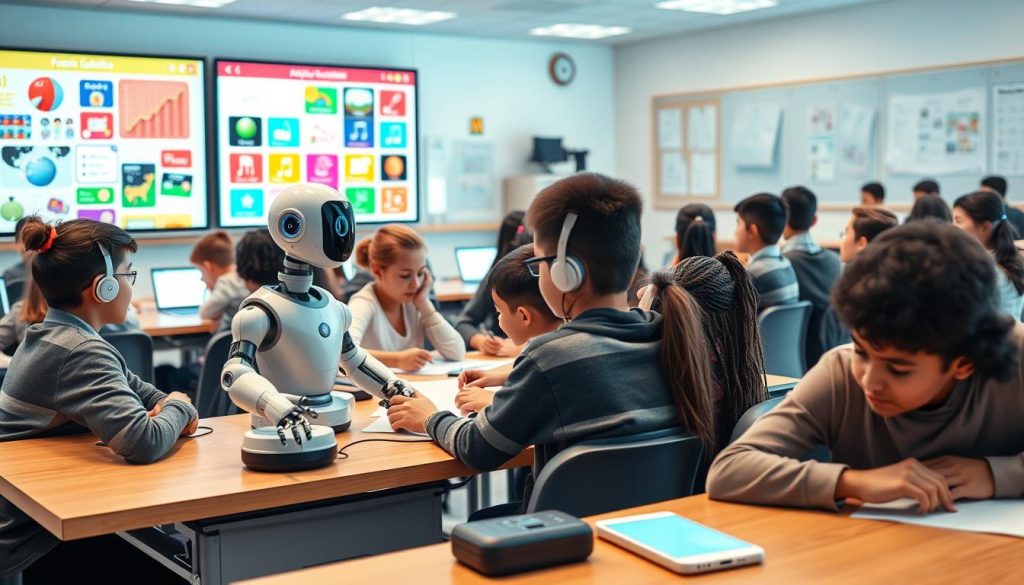
Self-paced education is key in this new frontier. AI assistants help students learn at their own speed.
Personal dashboards track progress. The Gates Foundation helps bring these tools to all students.
AI tutoring tools are now easier to make. Jill Watson took 1,000 hours to create.
New systems like Agent Smith only need 10 hours. This allows for more custom learning experiences.
AI brightens education's future. Korbit is making online courses with AI tutoring faster to create.
This tech opens doors to learning anything, anytime, anywhere.
"The evolution of instructional XR with AI is expected to provide personalized instruction for every child, creating true personalized learning experiences."
Only 4% of K-12 budgets go to education technology. There's huge room for growth in this area.
As we improve AI learning tools, we enter an exciting new era of education.
AI-assisted learning is changing education. It's reshaping how we learn and teach.
Let's explore the key AI learning benefits in education.
Self-paced education is a game-changer. AI lets me learn at my own speed.
This approach boosts student engagement by up to 30%. It's like having a tutor that fits my style.

AI tools give instant feedback, helping me improve. This cuts academic gaps by 15%.
It's like having a teacher available 24/7 for help.
AI tailors content to my needs by analyzing my work. This boosts academic performance by 20%.
It's like having a custom curriculum that grows with me.
"AI in education is not just about technology; it's about unlocking the full potential of every learner."
AI is a tool to enhance, not replace, traditional teaching. The goal is to create a balanced learning environment.
This combines the best of both worlds for effective learning.
AI study tools have changed how I learn. They make studying more efficient and fun.
AI-powered education offers personalized learning. I use software that adjusts task difficulty to match my skills.
This approach makes my study sessions more productive. It also makes them less overwhelming.
Here are some ways I've integrated AI into my studies:
The results have been great. In Mrs. Henderson's class, AI tools boosted test scores by 20%.
This success made me want to try more AI study tools.
AI should be approached responsibly as a learning supplement, not a replacement for engagement with study materials.
Using AI study tools the right way is important. My school offers workshops on using AI for studying.
These workshops help me get the most out of AI tools.
AI tools have improved my learning in many ways. I'm excited to be part of this new way of studying!
AI is changing education, but human teachers are still crucial. Most teachers believe their main job is guiding and mentoring students.
AI tools give quick feedback and spot where students need help. However, teachers bring empathy and creativity that AI can't match.
Most teachers say adapting to students' needs is vital. This flexibility is something only humans can truly provide.
Teachers now help students work together in class. They use AI to spark discussions and group projects.
Some 10th graders use AI chatbots in small groups. This helps them get feedback as they learn.
AI and human teachers can create a balanced education. Teachers use AI for routine tasks, freeing time for teamwork.
This mix of tech and human touch helps students. They develop critical thinking and problem-solving skills for the future.
"Technology should not replace teachers, but AI can serve as a valuable tool in their toolkit to enhance teaching and learning experiences."
AI is a powerful tool, but human teachers are irreplaceable. They inspire, empathize, and adapt for well-rounded learning.
AI technology is changing education. It enhances learning experiences and boosts student success.
Let's explore how AI can help us achieve better learning outcomes.
AI tools analyze data to understand each learner's pace and needs. This allows for personalized learning goals that adapt as students progress.
AI-powered analytics provide real-time insights into student performance. This instant feedback helps identify strengths and areas for improvement.
It allows for quick adjustments to learning strategies.
AI excels at study optimization. It identifies the most effective learning methods for each student.
AI creates a more effective and engaging learning environment. The future of education is here, powered by AI.
AI-assisted learning has amazing potential but faces some hurdles. In 2023, 60% of teachers will use AI in classrooms.
This change puts digital literacy at the front of educational concerns. Both educators and students need to adapt to new technologies.
Data privacy is a big AI learning challenge. Nearly half of teachers worry about security in AI education.
Training on data protection and GDPR compliance is crucial. It helps handle student information responsibly.
Cheating and plagiarism are also pressing issues. About 70% of teachers worry students might misuse AI tools.
Ensuring inclusivity with AI is vital. We must assess AI tools and bridge the digital divide.
We can provide alternative learning pathways. This helps harness AI's power while addressing its challenges in education.
"The key to successful AI implementation in education lies in balancing innovation with ethical considerations and inclusivity."
The future of education depends on how we adapt to AI. We must address digital literacy, data privacy, and ethical concerns.
This will create a stronger and more inclusive AI-assisted learning environment.
AI education is growing fast. Most leaders see its benefits, but few schools use it yet.
This gap means big chances for growth. AI will change education in exciting ways.
Many teachers use AI daily. Soon, smart systems will give quick feedback to students.
These tools will make custom lessons. They'll fit each student's own speed.
AI will use data to help teachers. It can spot students who need help early.
This tech could make test scores much better. It will make study plans for each kid.
VR will make learning more fun. Kids might take virtual trips or see 3D models.
AI-powered VR will make classes more real. It will help all students learn better.
AI-powered learning uses artificial intelligence to enhance education. It offers personalized experiences and adapts to each student's needs.
These tools provide round-the-clock support, changing how we approach learning.
ChatGPT acts as a digital tutor, giving quick answers to questions. It helps with research, writing, and language learning.
It's like having a smart friend ready to help anytime.
AI-assisted learning lets you learn at your own pace. It gives instant feedback and adjusts to your needs.
You get personalized content based on how you perform and what you like.
AI-powered learning can't fully replace human teachers. Teachers are key for building empathy and critical thinking skills.
The best approach mixes AI tools with human interaction for complete learning.
Use platforms like ChatGPT for research and writing help. AI tools are great for learning languages too.
Try different AI tools to find what works best for you.
Challenges include ensuring digital literacy and addressing data privacy concerns. It's important to avoid relying too much on AI.
Use AI tools responsibly while developing your critical thinking skills.
AI gives detailed info on your performance and spots areas to improve. It suggests personalized resources to help you learn better.
This data-driven approach helps optimize study habits and set achievable goals.
Future AI trends include automated grading and virtual tutors. Advanced learning analytics and virtual reality for immersive learning are coming.
These innovations will change how we learn in exciting ways.
AI gives quick access to info and personal help anytime, anywhere. It adapts to different learning styles and paces.
This makes education more accessible for everyone.
Adaptive learning adjusts to each student's needs and pace. It uses smart algorithms to give custom learning experiences.
These systems analyze your work to offer tailored content and tips.
