

Key Takeaways
- Minecraft enhances STEM learning by making complex concepts more accessible and engaging.
- Students develop crucial skills like creativity, problem-solving, and collaboration through Minecraft.
- Minecraft's immersive environment offers a unique platform for interactive and participatory learning.
- Educators can integrate Minecraft into their curriculum to support diverse learning styles and objectives.
- Real-world case studies show Minecraft's effectiveness in improving student motivation and academic performance.
Revolutionizing Learning by Teaching STEM with Minecraft
Imagine a classroom where students are eager to learn, where complex mathematical problems are solved not with a pen and paper but within the realms of a vibrant, block-based universe. This isn't a vision of the future; it's happening right now, thanks to Minecraft. As an educational tool, Minecraft is not just another game; it's a gateway to a world of endless possibilities, where the only limit is your imagination.
Minecraft's Role in Modern STEM Education
STEM education faces a unique challenge: it must evolve to keep pace with the rapidly changing world. Traditional teaching methods often struggle to captivate students' attention or provide them with a context for their learning. That's where Minecraft comes in. It's a game that's loved by millions around the globe, and when you blend its gameplay with educational content, you get a powerful tool that can transform the learning experience.
Most importantly, Minecraft teaches through experience. When students engage with the game, they're not just passively receiving information; they're actively creating, experimenting, and discovering. This active learning process is key to understanding and retaining STEM concepts.
Boosting Creativity and Problem-Solving Skills
Within the pixelated landscapes of Minecraft, students learn to think outside the box. They encounter problems that require creative solutions, whether it's building a sustainable farm or designing a circuit with Redstone. These challenges mimic real-world scenarios, teaching students that there's often more than one way to solve a problem.
Moreover, collaboration is a cornerstone of Minecraft's gameplay. Students can work together on projects, share resources, and brainstorm solutions. This not only enhances their problem-solving skills but also fosters teamwork and communication – essential components in any STEM field.
Why Minecraft Matters in STEM
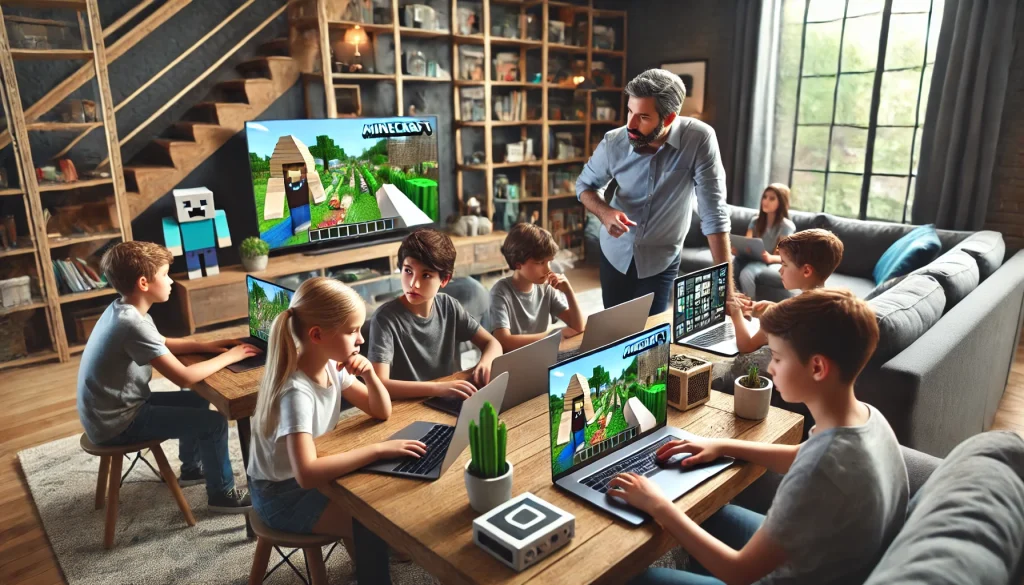
So, why is Minecraft such a game-changer for STEM education? The answer lies in its versatility and its ability to engage students on a level that traditional methods can't match. Let's dive deeper into why Minecraft is making waves in classrooms worldwide.
Understanding STEM Education Challenges
STEM subjects can be abstract and difficult to grasp. For some students, the leap from theory to practical application is a chasm they struggle to cross. Minecraft bridges this gap. By providing a visual and tactile environment, it allows students to see theories in action and understand their practical applications.
Realizing Potential Through Interactive Gameplay
When students play Minecraft, they're not just building structures; they're building their futures. They learn coding, engineering, and scientific principles in a way that feels natural and fun. Therefore, they're more likely to pursue these subjects outside the classroom and into their careers.
Because Minecraft mirrors the iterative process of scientific inquiry, students learn that failure is not an endpoint but a step towards success. They try different approaches, learn from mistakes, and try again – a mindset that's invaluable in any STEM field.
Bridge Building in Virtual Worlds
Let's get concrete about learning in the virtual world. Minecraft is a sandbox, which means it provides the tools, but the kids are the architects. They can build bridges, literally and figuratively, linking concepts they've learned in the game to the real world.
Concrete Learning in a Virtual Environment
Consider geometry, a subject that can be quite abstract. In Minecraft, students can build their own geometric shapes, exploring concepts like volume and surface area in 3D space. This hands-on approach not only solidifies their understanding but also makes learning geometry a whole lot more enjoyable.
Then there's physics. Students can experiment with gravity, friction, and properties of materials in a safe, controlled environment. They see the immediate impact of their actions, and because it's all happening within a game, they're learning without even realizing it.
Minecraft offers a unique and interactive way to explore chemistry concepts through hands-on learning. With the Minecraft Education Edition's Chemistry Resource Pack, students can experiment with creating compounds, performing chemical reactions, and understanding the elements from the periodic table—all within the game.
A popular mod called "MineChem" takes this a step further by allowing players to decompose Minecraft blocks into chemical components and use them to craft new items. This immersive experience helps students grasp complex chemistry topics by turning abstract concepts into practical, visual experiments that keep them engaged and curious.
From Pixels to Practice: Transpiring Skills
Now, you might wonder, how does building a virtual castle help in the real world? Well, it's about the process as much as the product. Students who design and construct in Minecraft are honing skills like spatial reasoning, resource management, and project planning. These are the same skills engineers, architects, and scientists use daily.
Take the story of a group of students who used Minecraft to simulate a Mars habitat for a school project. They researched the conditions on Mars, calculated what was needed to sustain life, and built a model of their habitat in the game. This project wasn't just about building in Minecraft; it was a lesson in research, astronomy, sustainability, and teamwork.
By tackling complex projects in Minecraft, students are laying the foundation for a strong STEM education – and having a blast while doing it.
Bringing the Virtual Minecraft into the Real World
Lego Minecraft Kits offer a hands-on way for kids to bring their favorite in-game engineering concepts into the real world. By building with these kits, children can explore basic engineering principles like structural design, problem-solving, and creativity.
With each piece, they can recreate familiar Minecraft structures, such as houses, farms, or even complex redstone contraptions, all while developing spatial awareness and fine motor skills. These simple projects not only fuel their imagination but also provide an engaging introduction to real-world engineering concepts, making learning both fun and practical. Through these kits, kids gain a better understanding of construction, physics, and teamwork, skills they can apply beyond the game.
Success Stories: Minecraft in the Classroom
Across the globe, educators are witnessing firsthand the transformative effects of Minecraft in their classrooms. From increased engagement to deeper understanding of complex concepts, the success stories are as varied as they are inspiring.
Case Studies of Minecraft-Enhanced Learning
One notable example comes from a middle school in Sweden, where students used Minecraft to create a model of their town's water purification system. Through this project, they learned about environmental science and urban planning, skills that are directly applicable to real-world issues.
Another success story involves a history class that rebuilt famous historical landmarks, allowing students to explore ancient civilizations in a way that textbooks could never match. They gained a deeper appreciation for history and architecture, understanding the past through a creative and interactive lens.
Moreover, a science teacher used Minecraft to teach genetics by having students breed virtual animals with different traits. This innovative approach helped students grasp the complexities of heredity and dominant-recessive genes in an engaging and memorable way.
These stories underscore Minecraft's potential as a versatile educational tool that can be tailored to a wide array of subjects and learning objectives. By leveraging its immersive and interactive nature, educators can create experiences that resonate with students and make learning come alive.
Teachers' Perspectives on Game-Based Education
Teachers who have embraced Minecraft in their classrooms often report that it's not just the students who are learning – they are too. They find themselves rethinking education, discovering new ways to deliver lessons that are more engaging and effective. They see students who were once disengaged become active participants in their learning journey.
Creating a Minecraft Learning Plan
Adopting Minecraft in education isn't about playing a game; it's about strategically integrating this tool into the curriculum. To do this effectively, educators need a solid plan that aligns with their learning goals.
Start by identifying the concepts you want to teach and consider how Minecraft can facilitate these lessons. Is it through a simulation, a building project, or perhaps a collaborative challenge? Once you have a framework, you can begin to weave Minecraft activities into your lesson plans.
Integrating Minecraft with Curriculum Goals
For integration to be successful, Minecraft activities must be tied to clear educational outcomes. For instance, if you're teaching geometry, you could have students calculate the area and perimeter of structures they build in Minecraft. If it's a science lesson on renewable energy, students could design and test various types of sustainable houses within the game.
Minecraft offers an engaging way to explore sustainable energy concepts through various mods that simulate renewable and alternative energy sources. Mods like "Immersive Engineering" and "IndustrialCraft 2" introduce players to solar panels, windmills, and waterwheels, allowing them to generate clean energy to power their in-game machinery.
Additionally, mods like "Mekanism" and "Big Reactors" take things further by incorporating nuclear power, offering players the chance to manage more advanced energy systems. In "Mekanism," for example, players can harness the power of nuclear fission to create massive energy outputs, but they must also handle the risks associated with radioactive waste.
These mods not only teach players about renewable energy but also expose them to the complexities of managing different energy sources, making Minecraft a powerful educational tool for sustainable energy and nuclear power exploration.
Resource Checklist for Educators
Before diving into Minecraft, here's a checklist to ensure you're prepared:
- A Minecraft: Education Edition license for each student
- Access to computers or tablets capable of running the game smoothly
- A clear understanding of the game's mechanics and features
- Lesson plans that incorporate Minecraft into educational objectives
- Support materials such as tutorials, worksheets, and assessment tools
- Guidelines for students to ensure a focused and productive gaming environment
With these resources in place, educators can confidently introduce Minecraft: Education Edition into their classrooms, creating a dynamic learning environment that captivates and educates in equal measure. For a more comprehensive look at Minecraft Education Edition, check out this article: Ultimate Minecraft Education Edition Guide: Tips, Lessons & Resources
Leveling Up: Advanced Minecraft Projects
For students who have mastered the basics, it's time to level up. Advanced Minecraft projects can challenge even the most adept young minds, pushing them to apply their STEM knowledge in new and complex ways.
Collaborative Challenges to Engage Students
Consider setting up a server where students can work on group projects that span multiple class periods or even grades. These could include large-scale builds like a model of the solar system or recreating historical events. Such projects not only deepen students' understanding of the subject matter but also teach them valuable lessons in teamwork and project management.
Another advanced use of Minecraft is to introduce students to coding. With the Code Builder feature, they can learn the basics of programming by controlling an in-game robot called the Agent. This hands-on approach demystifies coding and shows students how it can be used to create, control, and manipulate within a virtual world.
The possibilities are endless, and as students grow with the game, they're also growing their skills – skills that will serve them well in whatever STEM path they choose to follow.
Incorporating Coding into Minecraft Gameplay
For those who think Minecraft is just about mining and crafting, think again. One of the most exciting aspects of Minecraft in education is the opportunity to incorporate coding into gameplay. This isn't just any coding lesson; it's about bringing students' creations to life and seeing the immediate results of their code in a world they're already invested in.
Using tools like the Code Builder, students can learn the basics of programming in an environment that's both familiar and fun. They can control entities, automate tasks, and build complex systems, all through the power of code. It's a brilliant way to introduce the concepts of logic, sequencing, and computational thinking without the intimidation factor that often accompanies these subjects.
What's more, coding in Minecraft isn't a solitary activity. Students can share their code, work on projects together, and even troubleshoot each other's work. It's collaborative, it's creative, and it's exactly what the future of STEM education should look like.
FAQs
You've got questions, and I've got answers. Here's a rundown of some of the most common queries educators and parents have about Minecraft in STEM education.
What Makes Minecraft Suitable for STEM Education?
Minecraft is a natural fit for STEM education because it's a sandbox game that rewards creativity, problem-solving, and critical thinking. These are the very skills that form the foundation of STEM learning. In Minecraft, students can visualize mathematical concepts, apply scientific principles, and see the results of their engineering feats.
Furthermore, Minecraft's open-ended nature means that it can be used across all STEM disciplines. Whether it's creating a sustainable ecosystem, exploring the principles of electricity with Redstone, or using blocks to model chemical compounds, Minecraft provides a versatile platform for a wide range of educational experiences.
How Do I Get Started with Minecraft in My Classroom?
Getting started with Minecraft in your classroom might seem daunting, but it's easier than you think. Here's a quick start guide:
- First, ensure you have the necessary hardware – PCs, laptops, or tablets that can run Minecraft: Education Edition.
- Obtain Minecraft: Education Edition licenses for each student.
- Familiarize yourself with the game – you can find many tutorials and teacher resources online.
- Start with pre-made lesson plans that align with your curriculum and modify them to suit your class's needs.
- Set clear objectives for what you want your students to learn in each session.
Once you've got the basics down, you can start to explore more advanced features and even create your own custom lesson plans tailored to your students' interests and learning objectives.
Remember, the key to success with Minecraft in education is to keep the learning objectives at the forefront, ensuring that each activity has a clear educational purpose.
Can Minecraft Cater to Different Learning Styles?
Absolutely! One of the strengths of Minecraft is its ability to cater to a variety of learning styles. Visual learners can benefit from the game's graphical interface, while kinesthetic learners can engage with the hands-on building aspects. Auditory learners can follow spoken instructions and collaborate with peers, and reading/writing learners can benefit from in-game documentation and storytelling.
Because Minecraft offers so many ways to engage with content, it ensures that no student is left behind. It's a platform that encourages exploration and expression in ways that traditional teaching methods often cannot.
What Age Group Benefits Most from Minecraft Education?
Minecraft Education is versatile enough to benefit students of all ages, from elementary through high school. Younger students can learn the basics of collaboration, pattern recognition, and problem-solving, while older students can tackle more complex projects involving coding, scientific simulations, and detailed historical reconstructions.
The game's educational value grows with the student, offering more sophisticated challenges and learning opportunities as their skills develop. It's this scalability that makes Minecraft a lasting educational tool across grade levels.
How Does Minecraft Maintain a Balance Between Learning and Play?
Minecraft strikes a perfect balance between learning and play by embedding educational content within an engaging game environment. Students are motivated to learn because they're having fun, and they're having fun because they're empowered to be creative and in control of their own learning.
The game's design naturally encourages curiosity and exploration, which leads to learning that feels organic rather than forced. Teachers can guide this process by setting specific learning objectives and challenges that align with curriculum goals.
Ultimately, Minecraft respects the natural way that children learn – through play. By harnessing the power of play, Minecraft makes learning an adventure, not a chore. And that's the secret to its success in STEM education.